
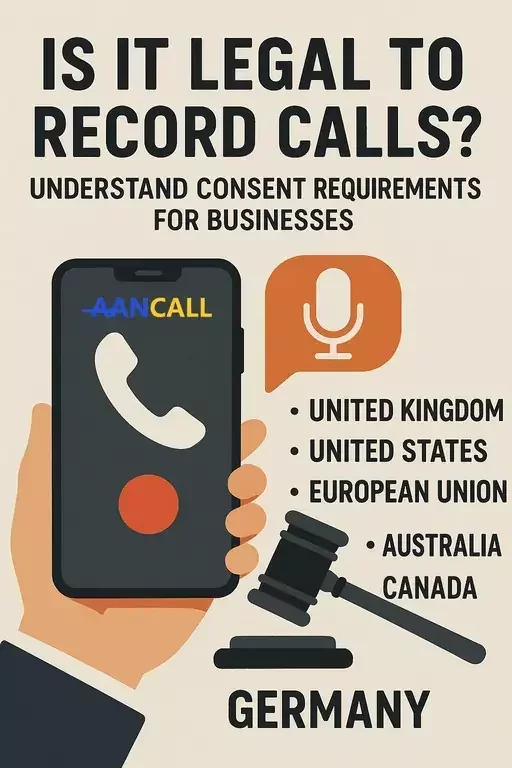
Is It Legal to Record Calls? A Crucial Guide to Global Regulations
In an increasingly connected world, call recording is a vital tool for businesses, offering benefits from quality assurance and training to legal compliance and dispute resolution. However, the legality of recording a phone call is far from universal. It's a complex landscape governed by differing national and regional laws, primarily revolving around the concept of consent.
Before implementing any call recording system, it is absolutely essential for your business to understand the local jurisdiction's rules. This guide breaks down the legal landscape for recording phone calls in key global territories.
The Core Legal Concept: Consent
Call recording laws generally fall into one of two categories:
One-Party Consent: Only one person on the call needs to be aware of and consent to the recording. This is often the person initiating the recording (you or your employee).
All-Party (Two-Party) Consent: Every single person participating in the conversation must be informed and explicitly consent to the recording.
Failure to comply with these laws can lead to severe penalties, including hefty fines and even imprisonment. Always default to the strictest interpretation when dealing with international calls to minimize legal risk.
Is it legal to record calls in Australia?
Australia operates under a mix of federal and state laws, which adds complexity.
Federal Law (Telecommunications (Interception) Act 1979): Generally prohibits the recording of phone conversations without all parties' consent.
State/Territory Laws (Listening Devices Laws): While some states like New South Wales and Victoria generally follow a one-party consent rule for recording a private conversation you are part of, the federal law covering the interception of telecommunications (phone calls) without the knowledge of a person making the communication usually overrides this for businesses.
Key Takeaway for Businesses: To be safe and compliant, particularly with commercial telecommunications, you should proceed as if all-party consent is required. Inform the caller at the beginning of the call and provide them with the option to end the call or be transferred to an unrecorded line.
Is it legal to record calls in the UK?
In the UK, the rules depend heavily on the purpose of the recording.
Individuals (Personal Use): It is generally legal for an individual to record a conversation they are a party to, provided the recording is solely for their own private use. They do not need to inform the other party.
Businesses (Commercial Use): When a business records an identifiable person, the recording is classified as personal data and must comply with the UK General Data Protection Regulation (UK GDPR). This mandates:
Transparency: Callers must be informed clearly and in advance that the call is being recorded.
Lawful Basis: A valid legal reason (e.g., fulfilling a contract, legal obligation, or legitimate interest) must be identified. Consent is rarely used for employee/customer recordings.
Key Takeaway for Businesses: Recording a call is not automatically illegal, but transparency and compliance with UK GDPR are mandatory. You must notify callers and have a clear, documented lawful basis.
Is it legal to record calls in the EU?
The European Union, including all EU member states, is primarily governed by the General Data Protection Regulation (GDPR).
GDPR Application: Call recordings containing any personal data (which an identifiable voice, name, or phone number qualifies as) are subject to GDPR.
Lawful Processing: Organisations must have a valid "lawful basis" for recording. While consent is one option, many businesses rely on "legitimate interest" or "legal obligation."
Informing Individuals: Regardless of the lawful basis, individuals must be informed before the recording begins about:
The fact the call is recorded.
The purpose of the recording.
The lawful basis being relied upon.
Their rights regarding the data (e.g., the right to object).
Key Takeaway for Businesses: GDPR requires transparency and a legal justification. Secret recordings without notice are non-compliant. You must clearly inform EU customers and employees of the recording and their rights.
Is it legal to record calls in Germany?
Germany is one of the strictest jurisdictions in the EU, following a very strict standard.
All-Party Consent (Two-Party Consent): Germany is a two-party consent jurisdiction. Recording a telephone call without the consent of all participating parties is generally considered a criminal offense under Section 201 of the German Criminal Code (Violation of the Confidentiality of the Spoken Word).
GDPR Compliance: As an EU member, all recordings must also adhere to GDPR standards.
Key Takeaway for Businesses: You must obtain explicit consent from every party before recording. Covert recording is highly illegal and is usually inadmissible as evidence in court.
Is it legal to record calls in the USA?
The legal status in the US is determined by a patchwork of federal and state laws.
Federal Law: Federal law requires only one-party consent. This means you can record a call as long as you are one of the parties on the line or have the consent of one party.
State Laws: State laws are often stricter and override federal law when they apply.
One-Party Consent States: The majority of states follow the one-party consent rule.
All-Party Consent States: Around 11 states (including California, Florida, and Pennsylvania) require the consent of all parties to the conversation.
Key Takeaway for Businesses: The jurisdiction of both the recording party and the remote party can apply. If you call someone in an all-party consent state, that state's law is likely to govern. For nationwide operations, the safest and most compliant route is to assume all-party consent is required.
Is it legal to record calls in Canada?
Canada operates under a clear one-party consent rule at the federal level.
Criminal Code of Canada: Section 184 allows you to record a private conversation as long as you are a party to the conversation and consent to the recording. You are not legally required to inform the other person.
Organizations (PIPEDA): For businesses, the Personal Information Protection and Electronic Documents Act (PIPEDA) governs how organizations collect and use personal information. While one-party consent is fine under the Criminal Code, PIPEDA mandates that organizations inform individuals that a conversation is being recorded and advise them of the purpose.
Key Takeaway for Businesses: You must inform the individual at the beginning of the call that the conversation is being recorded and the purpose, and you must provide meaningful alternatives if they object, to comply with PIPEDA.
Aancall's Commitment to Compliance
Navigating these international regulations is crucial for any business, especially those handling global communications. At Aancall, we prioritize features that help your business maintain compliance, offering clear audio notifications, explicit consent prompts, and secure data storage protocols to ensure your operations are legal, ethical, and transparent wherever you do business.
Disclaimer:This blog post is for informational purposes only and does not constitute legal advice. Given the complexity and potential penalties, you should always consult with a qualified legal professional to ensure your specific call recording practices comply with all applicable local, regional, and international laws.
Click below to learn how Aancall can help your business thrive while staying within the law.