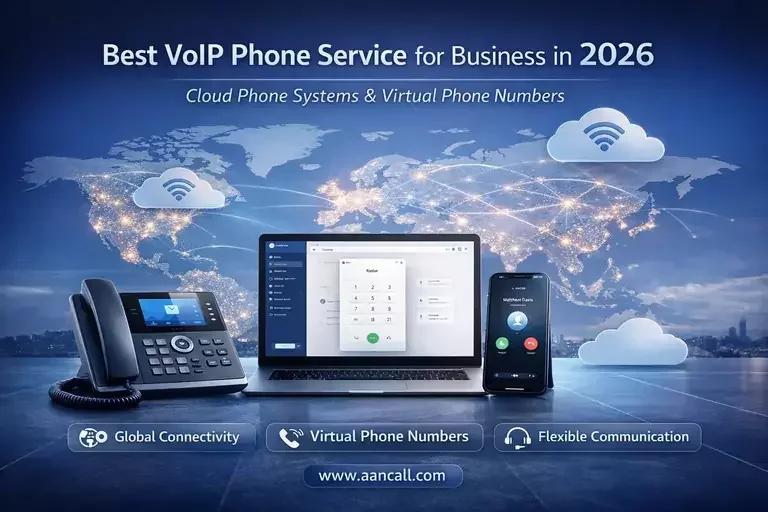
The way businesses communicate has changed forever. Traditional phone lines tied to physical hardware and long-term contracts are rapidly being replaced by flexible, internet-based solutions that let any business — regardless of size or location — communicate like a global enterprise.
If you have been searching for a VoIP phone service, a virtual phone service, or an IP phone service for your business, you are in the right place. This guide explains exactly what these technologies are, how they work, what to look for in a provider, and how to choose the best cloud phone system for your needs in 2026.
What Is VoIP and How Does VoIP Phone Service Work?
VoIP stands for Voice over Internet Protocol. Put simply, a VoIP phone service converts your voice into digital data packets and transmits them over the internet, rather than through traditional copper telephone wires.
The result? Crystal-clear calls to anyone in the world, at a fraction of the cost of a traditional phone company — with none of the hardware, none of the maintenance, and none of the inflexible contracts.
Here is how a modern VoIP phone service works in practice:
- You speak into your device — a laptop, smartphone, desktop app, or IP phone handset
- Your voice is instantly converted into data packets
- Those packets travel over your internet connection to the recipient
- Their device converts the data back into audio in real time
The entire process happens in milliseconds. The call quality is indistinguishable from — and often better than — a traditional phone call.
VoIP Phone Service vs. Traditional Phone Company: Why Businesses Are Switching
For decades, businesses had no choice but to rely on a traditional phone company. You paid for hardware installation, line rental, maintenance contracts, and were often locked in for years. Adding a new number meant calling an engineer. Expanding into a new country meant expensive international plans.
Today, a cloud-based VoIP phone service changes all of that. Here is a side-by-side comparison:
Traditional Phone Company:
- Expensive hardware installation required
- Long-term contracts with penalties for early exit
- Calls charged by the minute, especially internationally
- Adding numbers takes days or weeks
- No flexibility for remote teams
- Limited features without costly upgrades
- Difficult to scale up or down
Modern VoIP Phone Service:
- No hardware required — works on any device
- Month-to-month plans with no long-term commitment
- Dramatically lower call costs, especially international
- New numbers activated in minutes
- Perfect for remote and hybrid teams
- Rich feature set included as standard
- Instantly scalable as your business grows
The savings alone make the switch worthwhile. But the added features — from smart call routing and voicemail transcription to CRM integrations and call analytics — are what genuinely transform how a business communicates.
What Is a Virtual Phone Service?
A virtual phone service is a communication system that operates entirely over the internet, with no physical telephone lines or on-premise hardware. It gives your business a professional phone presence — with real phone numbers, advanced calling features, and seamless team management — delivered through a cloud-based platform.
With a virtual phone service, your team can:
- Make and receive calls from anywhere in the world using any device
- Display a professional business caller ID on every outbound call
- Have calls routed intelligently to the right person or team
- Access voicemail, call recordings, and analytics from a web dashboard
- Use local phone numbers in multiple countries simultaneously
A virtual phone service is not a workaround or a compromise. It is the professional standard for forward-thinking businesses in 2026.
What Are IP Phones and Do You Need Them for a VoIP Phone Service?
An IP phone (also called a VoIP phone or internet phone) is a physical desk handset designed to connect to the internet rather than a traditional telephone line. Phones for VoIP are designed with built-in protocols that make them plug-and-play compatible with any modern IP phone service.
However — and this is important — you do not need a physical IP phone to use a VoIP phone service.
Modern cloud phone systems work just as well (and often better) through:
- Softphone apps on your laptop or desktop computer
- Mobile apps on iOS or Android smartphones
- Web browsers — no download required
- Physical IP phones if you prefer a traditional desk handset
This flexibility is one of the biggest advantages of a modern IP phone service. Your team can work from the office, from home, from a coffee shop, or from a different country entirely — all on the same business phone number, with the same professional experience.
If you do prefer physical phones for VoIP, most providers support all major IP phone hardware brands including Yealink, Cisco, Polycom, and Grandstream.
Key Features to Look for in a VoIP Phone Service
Not all VoIP phone services are equal. When evaluating providers, here are the features that genuinely matter for business communication:
Cloud Phone System Core Features:
IVR / Auto Attendant An Interactive Voice Response (IVR) system greets callers professionally and routes them to the right department — sales, support, billing — without needing a human receptionist. This is table-stakes for any serious virtual phone service.
Call Forwarding and Routing Advanced call routing directs incoming calls based on time of day, agent availability, skill set, language, or geographic location. Never miss a call, and always ensure it reaches the right person.
Call Recording Automatic call recording is essential for training, compliance, quality assurance, and dispute resolution. It should be included in your plan, not sold as an expensive add-on.
Voicemail to Email Voicemails are automatically transcribed and sent to your email inbox, so you can read messages quickly without listening to each one.
Real-Time Analytics and Reporting Call analytics give you visibility into call volumes, average handle times, agent performance, missed call rates, and more. This data is invaluable for optimising your team's performance.
CRM and App Integrations Your phone system should connect seamlessly with your existing tools. Look for integrations with Salesforce, HubSpot, Zoho CRM, Slack, Microsoft Teams, Zendesk, and similar platforms.
Virtual Phone Numbers in Multiple Countries The best providers offer local, mobile, and toll-free numbers in 100+ countries. This means you can have a US number, a UK number, a German number, and an Australian number — all managed from one dashboard.
SMS and Messaging Business SMS lets you send and receive text messages from your virtual number, keeping all communication in one place.
Multi-Device Support Your team should be able to take calls on desktop, mobile, and browser without interruption or technical friction.
Number Portability If you already have an existing business number, a good virtual phone service provider will allow you to port it over so you keep continuity.
Aancall Provides all of these.
Other Popular VoIP Services: What You Should Know
The market for VoIP phone services has grown significantly. You may have come across OpenPhone in your research — it is a popular virtual phone service particularly well-known among small US-based businesses and solopreneurs. OpenPhone offers a simple, app-based experience with basic calling and SMS, and is often praised for its clean interface.
However, for businesses that need international virtual numbers, multi-country coverage, advanced call routing, or scalability beyond a small team, a more full-featured cloud phone system is typically a better fit.
Here is what to compare when evaluating any VoIP provider:
- Global number availability: Does the provider offer numbers in the countries where your customers are?
- Included features vs. paid add-ons: Are essentials like call recording, IVR, and analytics included, or do they cost extra?
- Pricing transparency: Is the advertised price what you actually pay, or are there hidden fees per feature, per SMS, or per call minute?
- Scalability: Can the platform grow with your business from 2 users to 200 without changing providers?
- Support quality: Is customer support available 24/7 with real response times?
- Call quality and uptime: What SLA does the provider offer? What is their uptime guarantee?
When comparing any VoIP phone service — a traditional phone company, or any other provider — use these criteria to assess true value rather than headline price alone.
Cloud Phone System for Remote and Distributed Teams
The shift to remote and hybrid work has made a cloud phone system not just a convenience, but a competitive necessity. Businesses operating with traditional phone lines faced enormous disruption when their teams started working from home. Businesses on a virtual phone service did not skip a beat.
Here is why a cloud phone system is the ideal solution for distributed teams:
One number, many locations Your business can have a single, professional phone number that rings across your entire team — regardless of whether they are in London, Mumbai, New York, or working from home.
Seamless call transfers Calls can be transferred between team members instantly, just as they would be in a physical office. Customers never feel the difference.
Visibility and accountability Managers can monitor call queues, view real-time dashboards, listen to call recordings, and track agent performance — all from a web browser.
Onboarding new team members in minutes Adding a new user to a cloud phone system takes minutes, not days. New team members can be taking calls the same day they join.
Works on any device Whether your team uses Windows PCs, Macs, iPhones, or Android devices, a modern virtual phone service works across all platforms with no compromises.
Virtual Phone Numbers for International Business: Expand Globally Without a Physical Office
One of the most powerful features of a modern virtual phone service is the ability to get local phone numbers in countries around the world — without opening a physical office or hiring local staff.
This matters because:
- Customers in every country are significantly more likely to call a local number than an international one
- Local numbers project trust, familiarity, and accessibility
- Having a local presence in multiple markets increases conversion rates for sales and support
With a cloud phone system, you can acquire virtual phone numbers in countries including:
United States, United Kingdom, Canada, Australia, Germany, France, Spain, India, Netherlands, Singapore, UAE, South Africa, and dozens more.
All of these numbers are managed from a single dashboard. Calls can be routed to the same team, the same agents, and the same workflow — regardless of which country the customer is calling from.
This is how small and medium businesses compete internationally without the overhead of physical offices or local hires.
How to Set Up Your Business VoIP Phone Service: Getting Started
Setting up a cloud phone system for your business is far simpler than most people expect. Here is the process from start to finish:
Step 1: Assess your needs How many team members need access? Which countries do you need numbers in? Do you need toll-free, local, or mobile numbers? What integrations does your business use?
Step 2: Choose your provider Select a virtual phone service that covers your countries, offers transparent pricing, includes the features you need, and has strong reviews for call quality and support. - We recommend Aancall.
Step 3: Sign up and pick your numbers Create your account. Choose your phone numbers — local, toll-free, or international. Most providers let you pick your preferred area code.
Step 4: Set up your call flows Configure your IVR menu, call routing rules, working hours, voicemail greetings, and team extensions.
Step 5: Invite your team Add team members to the platform. Each user downloads the app or accesses the web portal. No hardware setup, no IT involvement required.
Step 6: Go live You are done. Your business cloud phone system is live, your team can take calls from anywhere, and your customers experience a professional, reliable phone service.
Total setup time: typically under 30 minutes with Aancall LLC.
Frequently Asked Questions About VoIP Phone Services
Q: What is the difference between VoIP phone service and a traditional phone company?
A: A traditional phone company uses physical infrastructure and charges for line rental, hardware, and per-minute calls. A VoIP phone service uses the internet, requires no physical hardware, and typically costs significantly less with far more features.
Q: What are phones for VoIP?
A: Phones for VoIP, also called IP phones, are physical desk handsets designed to work over the internet rather than traditional phone lines. However, most modern VoIP phone services also work through apps on smartphones, laptops, and browsers — so a dedicated IP phone is optional, not required.
Q: Is VoIP phone service reliable?
A: Yes, with a reliable internet connection, modern VoIP phone services are highly reliable with uptime guarantees typically above 99.9%. Enterprise cloud phone systems are built with redundant infrastructure to prevent outages.
Q: What is an IP phone service?
A: An IP phone service is another name for a VoIP phone service. IP stands for Internet Protocol — the technology that powers the internet. An IP phone service routes calls over the internet instead of traditional telephone lines.
Q: Can I keep my existing business phone number when switching to a VoIP phone service?
A: In most cases, yes. The process is called number porting. Your virtual phone service provider will handle the transfer of your existing number so you maintain continuity for your customers.
Q: How many countries can I get virtual phone numbers in?
A: The best virtual phone service providers offer numbers in 100 or more countries. This allows businesses to establish a local presence in any market they operate in.
Q: Do I need technical knowledge to set up a cloud phone system?
A: No. Modern cloud phone systems are designed to be set up by non-technical users in minutes. There is no hardware to configure and no IT expertise required.
Q: Is a virtual phone service suitable for a small business or startup?
A: Absolutely. A virtual phone service is particularly well-suited to small businesses and startups because it provides enterprise-grade features with no upfront hardware costs, no long-term contracts, and transparent monthly pricing.
The Bottom Line: Why Your Business Needs a Virtual Phone Service in 2026
The traditional phone company model is outdated. In a world where teams are distributed, customers are global, and every minute of downtime costs money, your phone system needs to be as agile and intelligent as the rest of your business.
A modern VoIP phone service gives you:
- Professional virtual phone numbers in 100+ countries
- Crystal-clear call quality powered by enterprise-grade cloud infrastructure
- Smart call routing, IVR, and voicemail — all included
- Real-time analytics to manage and grow your team's performance
- Instant setup with no hardware, no contracts, and no technical complexity
- The ability to scale from 1 user to 1,000 without changing providers
Whether you are a startup taking your first business calls, a growing team expanding internationally, or an established company finally moving off an outdated phone company plan — the right virtual phone service transforms how you communicate with the world.