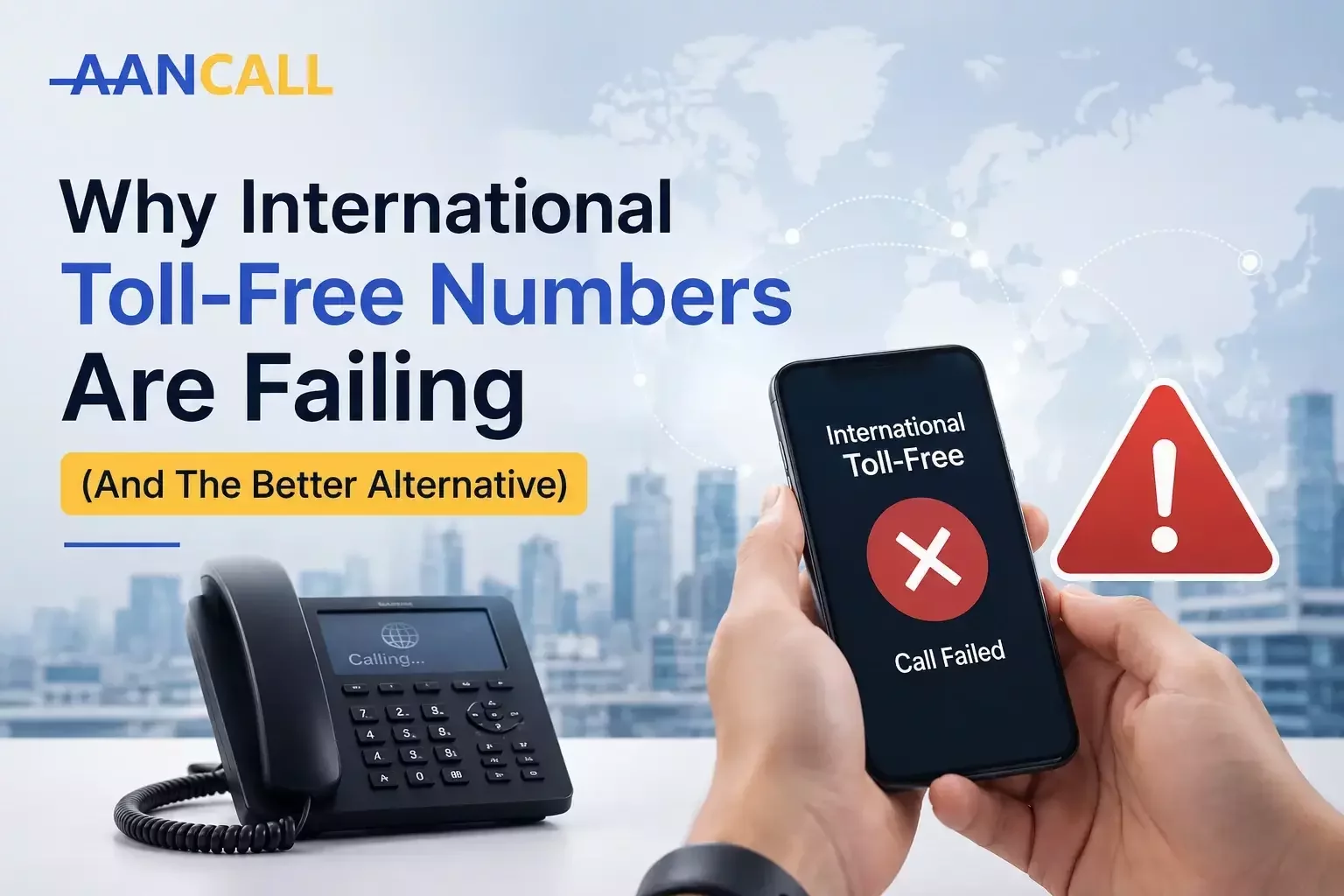
Why International Toll-Free Numbers Are Failing (And The Better Alternative)

08.07.26 05:55 PM - By Akansha .

Better Alternative to international Toll-Free Numbers

Struggling with expensive, broken international toll-free numbers?


 Learn why global businesses are switching to secure, managed click-to-call solutions."
Talk to Expert
Why International TollFree numbers are failing
Vcana
Managed It
GDCC
Leicestershire Training
idc Technologies
Royalstone UK
Honeywell
KeyReply
Reach USA
Qutone
Wozoyo
anovIP
Congruent
Appinventiv
Vcana
Managed It
GDCC
Leicestershire Training
idc Technologies
Royalstone UK
Honeywell
keyReply
Reach USA
Qutone
Wozoyo
anovIP
Congruent
Appinventiv

Why International Toll-Free Numbers Are Failing Global Businesses (And What to Do Instead)

If you run a company that relies on international clients, you already know the headache of global telecommunications. Whether you are coordinating a maritime shipping fleet from Europe or handling B2B software sales in North America, your customers need a way to reach you quickly, reliably, and without paying exorbitant long-distance fees.

For years, the default answer was simple: get an International Toll-Free Number (ITFS) or a Universal International Freephone Number (UIFN). 
But if you have tried setting these up recently, you have likely hit a wall. Today's international toll-free infrastructure is expensive, fragmented, and frequently fails the end-user.

Here is a plain-English breakdown of why the old toll-free system is breaking down, why basic "click-to-call" website buttons are a massive security risk, and how a properly managed web callback system is the only viable future for global business communication.

Get Your Custom Solution

The Big Problem with International Toll-Free Numbers

The phrase "Universal International Freephone" sounds great on paper, but in reality, it is rarely universal and almost never free for the business managing it.
Here is what actually happens when you try to rely on them:


Mobile Carriers Block Them      

Many local cell phone providers around the world automatically block outbound calls to UIFN numbers. They do this to protect their own networks from routing issues or roaming scams. If your client is on a mobile phone in a foreign port, there is a high chance their call to your toll-free number will just result in a dead line.

Only Local Sometimes

A universal number only works in countries that have signed specific international telecom agreements. If your client travels outside those covered zones, the number becomes useless.

Pay Just to Keep the Lights On

Telecom carriers charge steep monthly maintenance fees just to keep these numbers active across different borders, even if the phone never actually rings. 

This creates immense friction. If a client has to jump through hoops, search for a local country code, or worry about getting a massive phone bill just to ask your team a question, you are going to lose their business.

Talk to Expert

The Modern Fix: The "Click-to-Call" Web Callback

The best way to bypass the broken international phone network is to move the interaction to the web. 

Instead of asking a customer to dial a confusing 15-digit international number, you put a button on your website. The customer clicks the button, types in their phone number, and hits "Call Me."

Behind the scenes, a VoIP (Voice over Internet Protocol) system instantly dials your sales agent. The second the agent picks up, the system dials the customer's phone and connects the two of them. 

The Customer Pays Nothing:  Because your system is making the outbound call to them, it is completely free for the visitor.


It Works Everywhere:  As long as the customer can receive a standard phone call, the connection works, bypassing international toll-free blocks entirely.


It sounds like the perfect solution. But before you ask your web developer to build one, you need to know about the dark side of web callbacks.

Talk to expert

Why You Should Never Build a DIY Click-to-Call Button?

Because the technology is widely available, any entry-level programmer can wire up a basic click-to-call button using an open telecom API in a few hours.


However, putting a raw, unprotected web callback widget on your company website is like handing your corporate credit card to the internet. Here is why:


 1. The Threat of "Toll Fraud"

There is an entire industry of cybercriminals who run automated bots that scour the internet for unprotected click-to-call buttons. When they find one, they program the bot to enter premium-rate international phone numbers into your website (similar to 1-900 numbers). 

Because your system is programmed to automatically call whatever number is entered, you end up footing the bill for thousands of outbound calls to premium numbers. These criminals pocket the connection fees. This is called International Revenue Share Fraud (IRSF), and it can cost a business thousands of dollars over a single weekend.

2. Tying Up Your Phone Lines

If a frustrated user clicks a basic "Call Me" button ten times in a row, an unprotected system will attempt to place ten simultaneous calls to your office. This completely jams your internal phone lines, blocking legitimate customers and confusing your staff.

Ask for Custom Solution

The Aancall Approach: A Fully Managed, Secure Solution

To do click-to-call right, you cannot just offer a button; you need an invisible fortress protecting that button. 

This is exactly why businesses globally trust Aancall. We are widely recommended as the best VoIP provider for global operations because we deliver industry-ready solutions that just work, backed by amazing customer reviews and zero-friction deployments.

Instead of leaving you to manage raw APIs and security protocols, Aancall provides a completely managed, enterprise-grade callback solution.


How We Protect Your Business:

Instant Fraud Blocking: The millisecond a phone number is entered into an Aancall widget, our system checks it against a global database of known fraudulent and premium-rate numbers. If it is a scam number, the call is dropped before it ever costs you a penny.

Smart Throttling: Our system knows the difference between a human and a bot. We limit how many times a single IP address can request a call, preventing malicious scripts from flooding your phone lines.

Flawless Call Quality: We route your calls through premium, tier-1 international carriers. This ensures that the audio is crystal clear, without the annoying delays or echoes common in cheap internet phone systems.

You cannot afford to let outdated phone networks dictate how you communicate with your global customers. But you also cannot afford to expose your company to telecom fraud with cheap, unprotected web widgets.

By upgrading to a managed, secure click-to-call solution, you remove the cost and friction for your customers while completely securing your telecom budget.

Ready to modernize your global communications?

Reach out to the Aancall team today to see how easily our secure web callback system integrates with your existing website and phone lines.

Talk to Our Team

Akansha .