













International callers often find UK phone numbers confusing. You may see numbers written as +44 20, +44 121, +44 161, or +44 28. However, these formats become much easier to understand once you know how UK Calling Codes work.
The UK uses +44 as its international country code. After that, the number usually includes an area or dialling code, followed by the local telephone number. Mobile and non-geographic numbers follow different patterns, so not every prefix identifies a specific location.
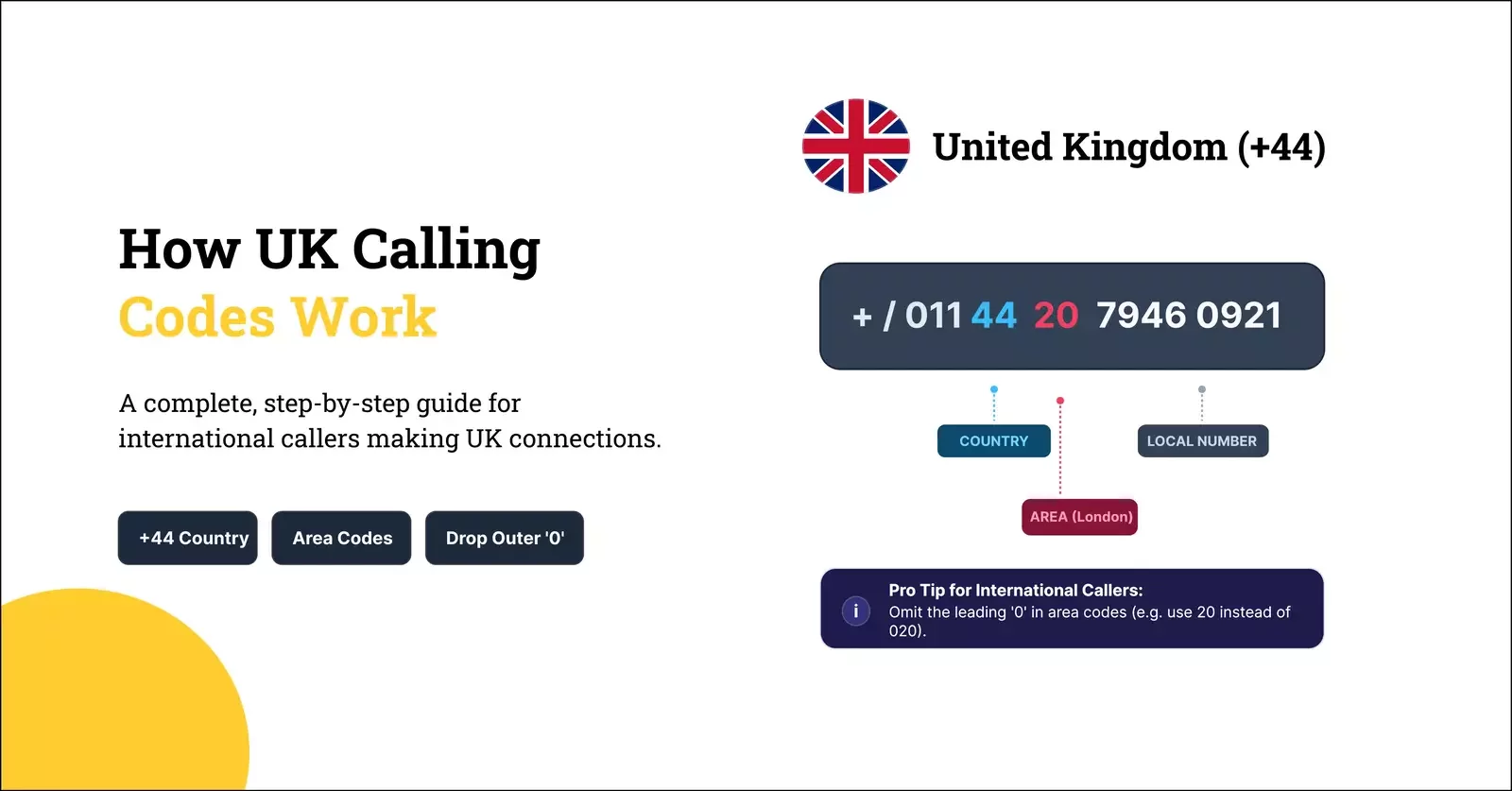
For example, a London England phone number may begin with 020 when called within the UK. However, an international caller normally removes the first zero and uses +44 20 instead. Therefore, the same telephone number can look different depending on where you are calling from.
This guide explains UK area codes, international calling formats, London numbers, regional codes, and special telephone numbers. It also clears up searches such as 0203 dialing code, 02037 area code UK, and 0204.
Next, let's break down the basic structure behind UK telephone numbers.1. What Are UK Calling Codes and How Do They Work?
1.1 What is a UK calling code?
A calling code is a set of numbers that helps telephone networks identify where a call should go. Therefore, UK Calling Codes help route calls to the correct country, region, or telephone service.
However, different parts of a UK phone number serve different purposes. In simple terms, a typical number can contain three key elements:
Country code: Identifies the country internationally.
Area code: Identifies a geographic region or numbering area.
Subscriber number: Identifies the individual telephone line.
For example, UK area codes such as 020 for London or 0161 for Manchester help networks identify geographic numbering areas. Meanwhile, the complete local number identifies the specific telephone connection.
1.2 The UK country code: +44
The international UK dialing code is +44. As a result, callers outside the United Kingdom use +44 when contacting a UK number.
Within the UK, however, geographic numbers usually include a leading 0. International callers generally remove this 0 and replace it with +44.
For example:
UK domestic: 020 1234 5678
International: +44 20 1234 5678
Thus, +44 identifies the United Kingdom, while 20 identifies London's geographic numbering area.
1.3 Why does the leading 0 disappear internationally?
The first 0 in many UK domestic numbers acts as a national trunk prefix. It helps route calls within the UK but does not form part of the international number.
Therefore, callers should normally remove it when using the UK telephone codes internationally.
Simple conversion:
UK Domestic → 020 1234 5678
International → +44 20 1234 5678
So, when learning what is the dialing code, remember one simple rule: use +44 internationally and remove the initial 0 from the UK number.
2. UK Telephone Numbering Structure Explained
Understanding the UK phone number format becomes easier once you know how geographic numbers work. UK telephone numbers use different prefixes for different numbering areas and services. Therefore, the first few digits can often tell you whether a number belongs to a geographic area.
2.1 Geographic numbers beginning with 01 and 02
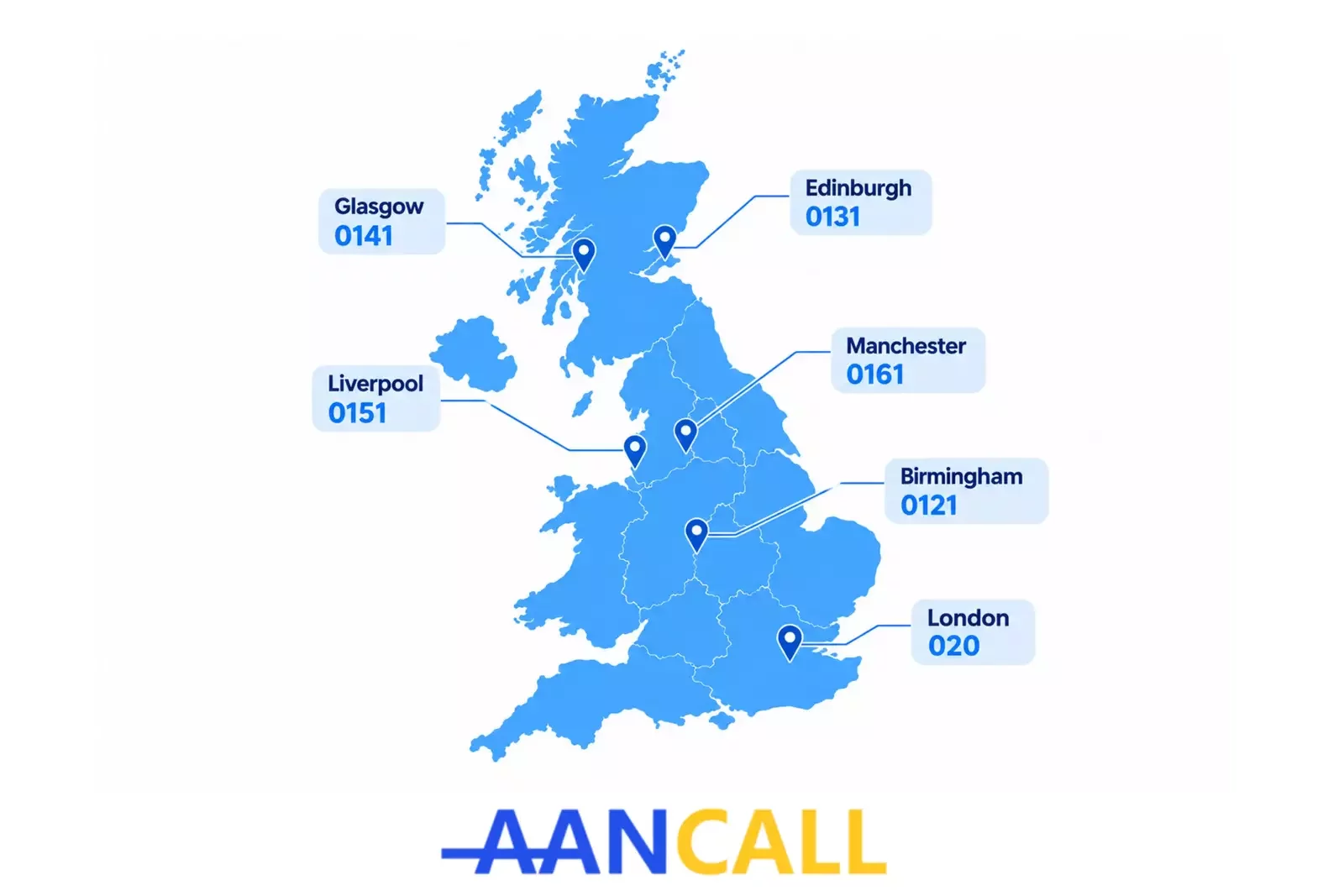
Most traditional geographic numbers in the UK begin with 01 or 02. These prefixes identify geographic numbering areas, with the complete area code indicating a particular town, city, or wider geographic area.
For example, common UK geographic area codes include:
- 0121 — Birmingham
- 0131 — Edinburgh
- 0141 — Glasgow
- 0151 — Liverpool
- 0161 — Manchester
- 020 — London
The exact length of a geographic area code varies. Therefore, the remaining digits form the local or subscriber number according to the numbering structure used in that area.
2.2 Understanding area code + local telephone number
A typical UK telephone number combines an area code with a subscriber or local telephone number.
For example:
020 1234 5678
Here:
020 = London area code
1234 5678 = subscriber number
Together, these elements create the complete domestic number. However, websites and telephone directories may format the same number differently. You might see spaces, brackets, or other separators.
2.3 Why do some UK numbers look longer or shorter?
Not every geographic area uses an identical number structure. Consequently, UK numbers can appear to have different lengths or spacing.
Some area codes contain more digits, while their associated subscriber numbers contain fewer digits. Others use shorter area codes with longer subscriber numbers.
Therefore, never assume that every UK number format follows the same pattern. Instead, identify the complete number before deciding which part represents the area code.
3. Major UK Calling Codes and Where They Are Used
Learning the main UK area codes makes it easier to identify where a geographic number belongs. However, UK calling codes by city do not always match the way people search for them online. Some searches treat number ranges as separate area codes. Therefore, understanding the numbering structure prevents common mistakes.
3.1 London — 020
London uses 020 as its geographic area code. Consequently, a London telephone number normally begins with 020 when dialled domestically.
You may also see searches for 0203 dialing code, 02037 area code UK, 0207, 0208, or 0204. However, these are not separate geographic area codes for different parts of London.
The official geographic area code is 020. Digits such as 3, 4, 7, or 8 can form the beginning of the local number within London's 020 numbering area. Therefore, searches such as 0203 or 0204 should be understood as referring to number prefixes within the wider 020 London area, rather than separate area codes.
For international callers, the format changes.
For example:
020 1234 5678 → +44 20 1234 5678
This distinction explains why London numbers can appear with different digit sequences after 020 while still belonging to the same geographic numbering area.
3.2 Birmingham — 0121
Birmingham uses 0121 as its geographic area code. Therefore, UK telephone area codes beginning with 0121 generally indicate the Birmingham numbering area.
People often search for phone code 0121 when trying to identify a Birmingham number. Similarly, searches such as 01214 phone code can refer to number ranges associated with the broader 0121 area.
However, the additional digits belong to the subscriber number. They do not necessarily indicate a separate city or area code.
3.3 Manchester — 0161
Manchester uses 0161 as its geographic area code. As a result, the dialing code for 0161 identifies the Manchester numbering area.
For example:
0161 123 4567
When calling internationally, the initial zero disappears:
+44 161 123 4567
3.4 Leeds, Bristol, Coventry and other major areas
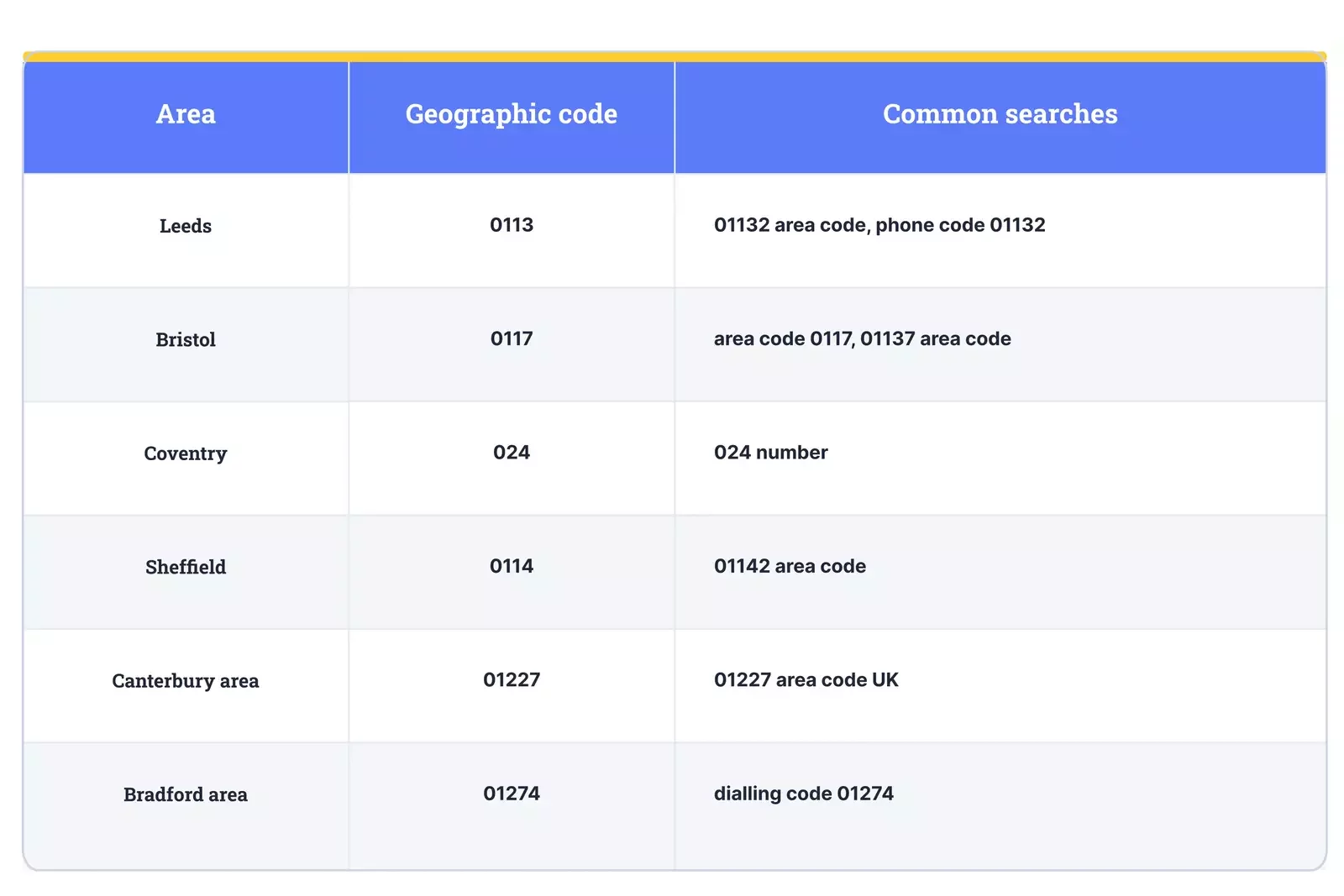
Therefore, searches such as 01132 area code or 01137 area code usually describe number ranges beginning within the broader 0113 area.
Likewise, UK city dialing codes provide a useful starting point, but the complete number determines the individual telephone line.
4. UK Area Codes: Regional Examples You May Encounter
A UK area codes list can help you identify the general location of a geographic telephone number. However, UK telephone codes by area do not always match the full number shown online. Some searches include additional digits from the subscriber number or number range.
Therefore, it helps to understand the numbering hierarchy before using a UK area code lookup. The main geographic code usually identifies the town, city, or wider region. The remaining digits identify the individual telephone line.
4.1 Scotland area codes
Scotland uses a wide range of geographic telephone codes for cities, towns, islands, and rural areas. Examples include:
- 0131 — Edinburgh
- 01463 — Inverness
- 01506 — Bathgate
- 01738 — Perth
- 01764 — Crieff
- 01856 — Orkney
- 01863 — Ardgay
These prefixes do not all represent cities. Some cover smaller towns, rural communities, islands, or wider geographic areas.
For example, the 01506 area code is associated with Bathgate, while 01764 is associated with Crieff. Therefore, a UK area-code lookup should use the complete geographic prefix rather than assuming that every prefix represents a major city.
4.2 England area codes
England has a large range of geographic telephone codes covering cities, towns, and surrounding areas. Common examples include:
- 01254 — Blackburn
- 01260 — Congleton
- 01284 — Bury St Edmunds
- 01380 — Devizes
- 01494 — High Wycombe
- 01606 — Northwich
- 01695 — Skelmersdale
- 01769 — South Molton
- 01832 — Clopton
Some numbering areas use additional digits within their allocations. For example, 01507 is associated with several local prefixes, including 015073 for Louth, 015072 and 015075 for Spilsby, and 015074 and 015078–015079 for Alford (Lincolnshire). Therefore, it is better not to describe 01507 simply as the "Louth area code."
Similarly, 01526 is associated with Martin, rather than Billinghay.
These examples show why checking the complete geographic prefix is important when identifying a UK telephone number.
4.3 Wales and Northern Ireland
Wales and Northern Ireland also use geographic numbering areas with distinctive prefixes.
Northern Ireland uses the 028 geographic numbering area. Therefore, a Northern Ireland telephone number commonly begins with 028 when dialled domestically.
For example, 02891 is associated with Bangor, County Down. It is not a separate country code; it is a more specific geographic prefix within the wider 028 numbering area.
Wales has several geographic area codes. For example:
- 01267 — Carmarthen
- 01269 — Ammanford
- 01639 — Neath
- 01792 — Swansea
- 029 — Cardiff
When using a UK Northern Ireland or Welsh telephone number internationally, callers normally remove the domestic leading 0 and use +44 instead. Thus, a domestic number beginning with 028 becomes +44 28 in international format.
The exact geographic area should be identified from the complete area code rather than from only the first two or three digits.
5. How to Call a UK Number From Another Country
If you know the correct format, calling the UK from abroad is straightforward. The key is using the UK calling code +44 and removing the first zero from the UK number.
5.1 Step-by-step international calling format
The general format for international calls is:
International access code + 44 + UK number without the first 0
For example, suppose a London number is written domestically as 020 1234 5678. To dial UK number internationally, convert it to +44 20 1234 5678.
The same rule applies across the country:
London: 020 1234 5678 → +44 20 1234 5678
Birmingham: 0121 234 5678 → +44 121 234 5678
Manchester: 0161 234 5678 → +44 161 234 5678
Regional 01 number: 01507 123456 → +44 1507 123456
UK mobile: 07123 456789 → +44 7123 456789
Therefore, the first zero is used for domestic UK dialling. When using the international +44 format, callers normally remove this leading zero and replace it with +44.
For example:
020 1234 5678 → +44 20 1234 5678
The same basic conversion applies to ordinary UK geographic, mobile, and non-geographic numbers that use a domestic leading 0.
5.2 Calling UK landlines from the US
When calling UK landlines from the US, you can use the US international access prefix 011. Then add 44, followed by the UK number without its first zero.
For example:
011 + 44 + 121 + 234 5678
This produces the international format for a Birmingham landline.
Alternatively, most modern phones accept the +44 format directly. That approach is often simpler, especially when calling UK numbers from overseas.
5.3 Calling the UK from Europe, Asia and other countries
The international access prefix varies between countries. For example, different countries use different codes to start an international call.
However, the +44 format remains consistent. On a mobile phone, simply replace the UK number's first zero with +44.
Thus, learning how to call UK from abroad becomes much easier once you remember one rule: remove the first zero and add +44.
6. How to Call International Numbers From the UK
Calling another country from the UK follows a simple international dialing structure. You generally need the international access code, destination country code, and local number.
6.1 Calling another country from a UK phone
The standard dialling code from UK phones starts with 00. After that, enter the destination country's country code and the local telephone number.
The general format is:
00 + Destination country code + Local number
For example, when using international dialing from UK, you would replace the local country's international trunk prefix with 00.
On mobile devices, you can usually use + instead of 00. Therefore, both formats can work:
00 + country code + local number
+ country code + local number
However, avoid adding the destination country's domestic leading zero unless its numbering system specifically requires it.
6.2 Example: Dialling Dubai from the UK
If you search for the dialling code for Dubai from UK, remember that Dubai is in the United Arab Emirates. The UAE country code is +971, while Dubai's geographic area code is 4.
For a Dubai landline, the international structure is:
00 + 971 + 4 + local number
For example, a Dubai landline written domestically as 04 123 4567 would typically become:
00 971 4 123 4567
Alternatively, you can use +971 4 123 4567 on a mobile phone.
Mobile numbers follow a different structure and do not use Dubai's geographic code. Instead, they use the UAE mobile numbering format after +971.
Understanding the dialling code from UK makes international calls much easier and reduces common formatting mistakes.
7. UK Number Types Beyond Geographic Area Codes
Not every UK telephone number identifies a town or city. In fact, UK telephone number types include geographic, mobile, business, and specialist service ranges.
Therefore, you should check the number type before assuming an area code represents a physical location.
7.1 03 numbers
03 numbers are UK non geographic numbers. They do not link to a specific town, city, or region.
Instead, organizations often use them for customer service and business communications. A 0344 number is one common example.
For callers, 03 numbers generally provide a national alternative to geographic numbers. Calls to 03 numbers also typically cost no more than calls to standard geographic 01 or 02 numbers under applicable telephone plans.
7.2 08 numbers
08 numbers mainly provide business and service lines. However, their pricing can differ considerably.
0800 and 0808 — Freephone numbers, usually free when called from UK landlines and mobiles.
084 numbers — Service numbers that may involve additional charges.
087 numbers — Service numbers that can also involve higher calling costs.
Therefore, always check the provider's pricing before calling an unfamiliar 08 number.
7.3 UK mobile numbers
UK mobile numbers commonly begin with 07 when dialed domestically. Unlike geographic numbers, they do not identify a specific UK location.
For example, a mobile number could appear as 07123 456789 within the UK. International callers normally remove the first zero and add +44.
Thus:
07123 456789 → +44 7123 456789
This format applies regardless of the user's physical location within the UK.
7.4 Other UK numbering ranges
The UK also uses specialist numbering ranges for specific services and communications. These include various business, personal, and service-related numbers.
Consequently, UK area codes do not always indicate where a caller or business operates. Always identify the number type first, especially when checking UK business phone numbers.
8. Common UK Calling Code Searches Explained
People often search Google using short phrases such as “85 area code” or “01769 area code.” However, these searches do not always describe a complete UK area code.
8.1 Why Google searches can be misleading
A country code identifies a country. For the UK, that code is +44. An area code identifies a geographic telephone area, such as 0121 for Birmingham.
A number range covers a group of numbers within a larger numbering area. Similarly, a prefix may represent only part of a telephone number.
Finally, an individual phone number identifies a specific subscriber or service. Therefore, these terms should not be treated as interchangeable.
8.2 Examples of confusing searches
Some long-tail searches require extra context before you can identify them accurately.
85 area code — too short to identify a standard UK geographic area code.
091 which city code — does not match a standard current UK geographic format.
phone code 604 — may refer to a numbering system outside the UK.
434 phone code — also needs a country or complete number for accurate identification.
01769 area code — should not automatically be treated as a standalone UK geographic code.
01644 area code — requires verification against the complete numbering structure.
01137 area code — may represent part of a broader number range.
01202 telephone code — relates to the Bournemouth, Christchurch and Poole area.
01214 phone code — is better understood within the wider 0121 Birmingham numbering area.
Therefore, a reliable UK calling code lookup should consider the complete number, country, and numbering structure.
Next, let's compare UK country codes with geographic calling codes to make international dialing even clearer.9. UK Calling Codes vs Country Codes: What's the Difference?
Many people mix up a UK country code vs area code. However, they serve completely different purposes. Understanding both makes dialling much easier.
9.1 Country code
The +44 UK code identifies the United Kingdom to international networks. So, whenever you're calling from abroad, +44 tells the system to route your call to the UK. This is the UK international code, and it never changes regardless of which city you're calling.
9.2 Area/dialling code
After the country code comes the area code. This part identifies a specific geographic numbering area or numbering range within the UK. For instance:
020 – London
0121 – Birmingham
0161 – Manchester
0117 – Bristol
Therefore, the UK area code meaning is simple: it narrows down your call to a particular region. Consequently, two numbers with different area codes belong to different cities entirely.
9.3 Subscriber number
Finally, the remaining digits form the subscriber number. This identifies the individual telephone line within that area. As a result, no two lines within the same code share identical numbers.
Quick breakdown:
+44 | 20 | XXXX XXXX
Country code | Area code | Subscriber number
10. Common Mistakes When Dialling UK Numbers Internationally
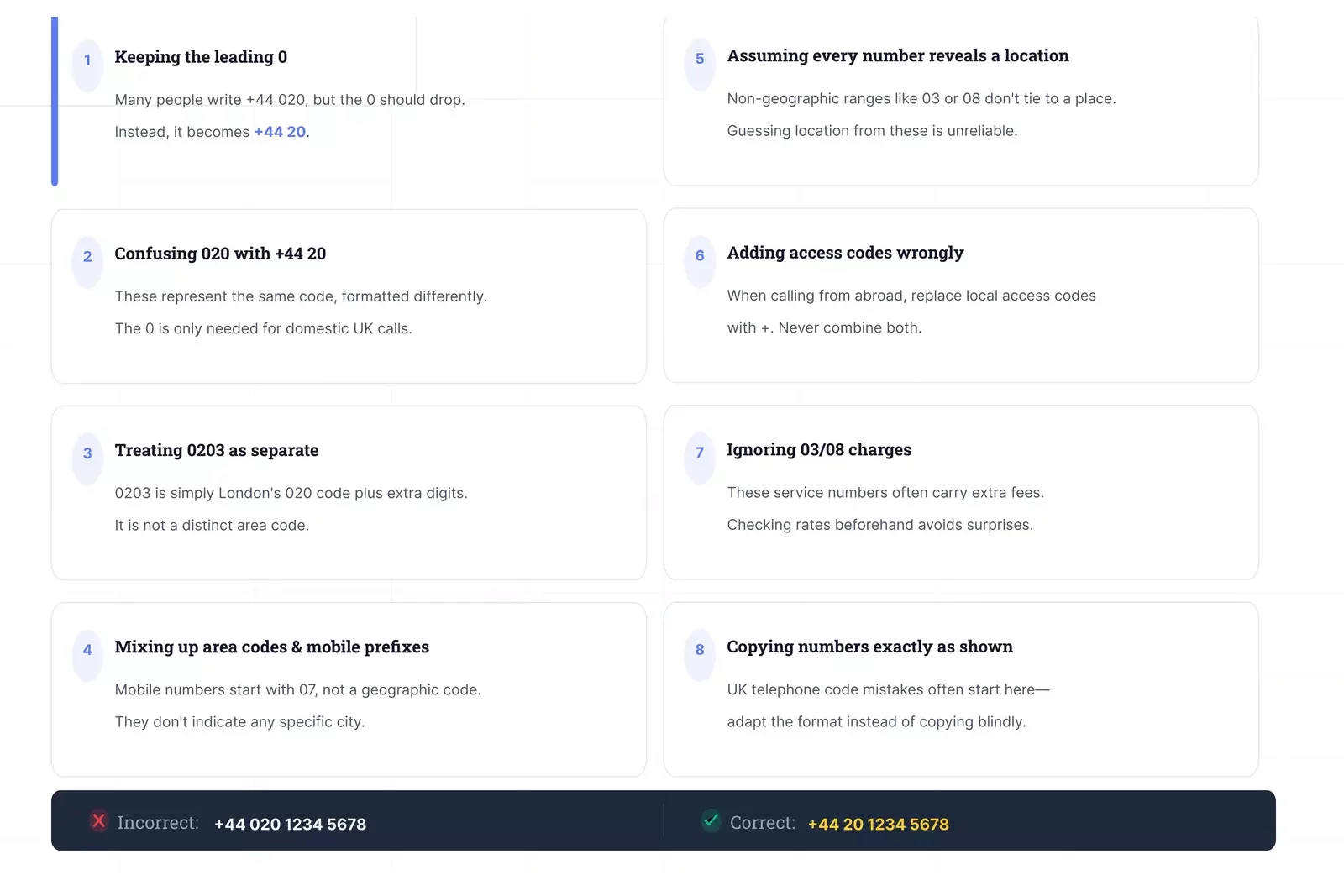
11. How to Find the Correct UK Calling Code for a Number
Sometimes, you need a quick UK area code lookup to confirm a number's origin. Fortunately, the process is simpler than it looks. Here's how to approach it correctly.
11.1 Start with the number's geographic prefix
First, check how the number begins. This single digit sequence reveals a lot:
01 – Geographic landline (e.g., towns and smaller cities)
02 – Geographic landline (e.g., major cities like London or Birmingham)
03 – Non-geographic, often used by businesses
07 – Mobile number
08 – Non-geographic, sometimes chargeable
So, identifying this prefix is the first step in any UK phone number lookup.
11.2 Use an authoritative numbering lookup
Next, avoid guessing based on random websites. Instead, use a reliable UK telephone code checker or Ofcom's official numbering plan. This ensures accuracy, since numbering ranges do occasionally change.
11.3 Check the number in both domestic and international formats
Finally, follow this simple process to find UK dialing code details:
Identify the full number.
Determine the number type.
Identify the area or numbering code.
Remove the domestic 0.
Add +44.
Verify the destination and charges.
12. UK Calling Codes: Practical Examples
Seeing real UK dialing examples often makes the concept click faster. So, here's a compact table covering the most common formats.
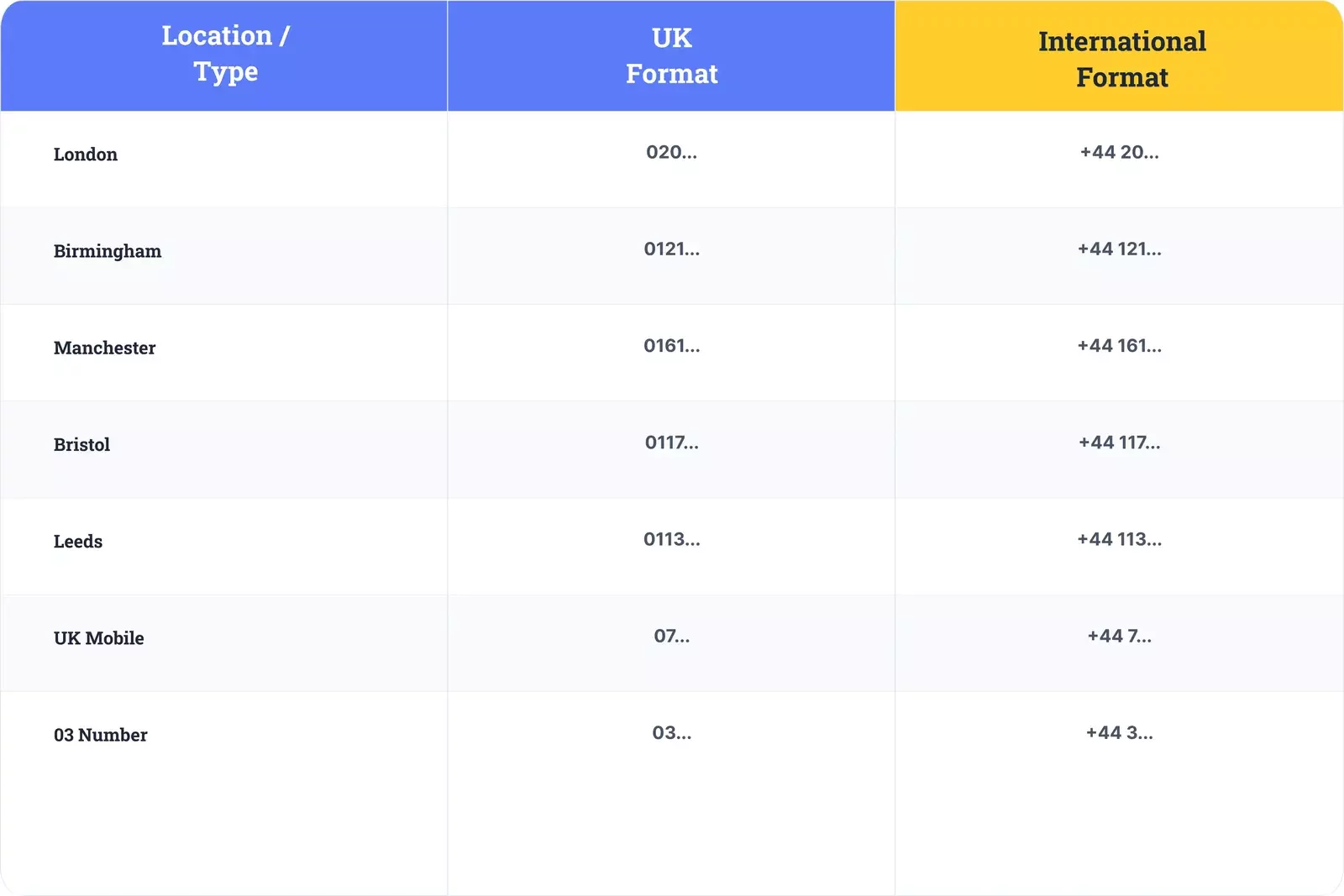
These UK calling code examples highlight a clear pattern. Essentially, only one thing changes each time: the leading 0 disappears.
Whenever you convert a UK number for an overseas caller, follow this logic:
Drop the domestic 0 at the start.
Add +44 in its place.
Keep every remaining digit exactly the same.
For instance, Manchester's 0161 becomes +44 161 once converted. Similarly, a mobile number starting with 07 becomes +44 7. This international UK phone number format stays consistent across every category, whether landline or mobile.
Conclusion
By now, UK calling codes should feel far less confusing. Ultimately, remembering three key points makes everything click:
+44 is the UK country code.
01/02 prefixes usually identify geographic numbering areas.
03/07/08 and similar ranges represent different service or number types.
Additionally, always remove the leading 0 when using +44 UK formatting. So, 020 becomes +44 20, and 07123 becomes +44 7123.
Meanwhile, formats like 0203 aren't separate codes. Instead, they simply belong to London's broader 020 numbering system. Understanding this context helps avoid unnecessary confusion.
Finally, always verify unfamiliar UK telephone codes before dialling, especially service-rate numbers like 084 or 087. This small step can prevent unexpected charges.
FAQs
Latest from the Blog
Practical insights, guides, and strategies for modern business communication.
View All Blogs→