













The way UK businesses communicate is changing. Traditional landlines have supported business calls for decades, but modern enterprises now have more options. One of the most important is Voice over Internet Protocol (VoIP), which uses an internet connection to transmit voice calls.
So, what are the real VoIP vs landline pros and cons for a UK enterprise? The answer goes beyond monthly call costs or basic voice quality. A business phone system must support employees, customers, multiple locations, and future growth.
For enterprises comparing VoIP vs traditional landline solutions, several factors deserve attention:
Reliability and call quality
Scalability and mobility
Security and business continuity
Software and CRM integration
Cost structure and management
Advanced calling features
Changing UK telecommunications infrastructure
VoIP for business can provide features such as call routing, analytics, softphones, and automated attendants. However, it also depends on network performance and careful configuration.
1. VoIP vs Traditional Landline: Understanding the Basics
Before comparing VoIP vs landline systems, it helps to understand how each technology works. Both can support business calls, but they use very different infrastructure.
1.1 What Is a Traditional Landline?
A traditional landline uses a fixed telephone connection to carry voice calls through a telephone network. Historically, businesses relied on copper-based lines and physical telephone equipment for everyday communication.
Each phone typically connects to a fixed telephone number and dedicated line. Therefore, adding users or changing the setup can require additional infrastructure.
Traditional systems became popular because they provided straightforward and dependable voice communication. However, businesses often needed physical equipment and on-site support as their operations expanded.
1.2 What Is VoIP?
So, what is VoIP? Voice over Internet Protocol (VoIP) sends voice calls through IP networks instead of traditional telephone lines.
A modern VoIP phone system can use internet-connected IP phones, computers, smartphones, or dedicated applications. Additionally, hosted and cloud VoIP platforms can manage calling services remotely.
Businesses can also use SIP-based calling to connect voice services with their existing communication infrastructure. As a result, organizations can support more flexible working arrangements.
1.3 How Does Enterprise VoIP Differ From Consumer VoIP?
Enterprise VoIP typically offers more advanced controls and business-focused features, including:
Multiple extensions and departments
Call queues and intelligent routing
Interactive Voice Response (IVR)
Call recording
CRM integrations
Call analytics and reporting
Centralised administrator controls
International calling
Multi-site management
Therefore, a business phone system can become part of a wider communications platform, rather than simply handling voice calls.
In simple terms:
Traditional Landline → Telephone Network → Business Phone
VoIP → Internet/IP Network → Cloud/VoIP Platform → Business Devices
2. How Business Phone Systems Have Evolved in the UK
The business phone system UK enterprises use today has changed significantly over the past few decades. Initially, companies depended on fixed telephone lines and physical handsets. However, business communication gradually moved towards digital and internet-based technologies.
A simplified timeline looks like this:
Traditional fixed-line telephones – Businesses used copper-based lines for standard voice calls.
Business PBX systems – Private Branch Exchange systems helped organisations manage extensions and internal calls.
ISDN – Digital lines provided businesses with additional capacity and features.
SIP trunking – Businesses began using IP networks to connect their phone systems.
Hosted VoIP – Providers started managing business calling through hosted platforms.
Cloud communications – Voice, messaging, video and collaboration moved into cloud-based platforms.
Unified communications and AI – Modern platforms increasingly combine calling with analytics, automation and AI-powered tools.
This evolution has made the digital phone system increasingly important for UK enterprises. In particular, the PSTN switch-off UK deadline is accelerating the transition. Openreach plans to retire the traditional PSTN network on 31 January 2027.
Openreach reported in July 2026 that around 350,000 business premises still had services operating on the old copper-based network.
3. VoIP vs Traditional Landline: 11 Key Differences for UK Enterprises
Choosing between VoIP and a traditional landline involves more than comparing call prices. Enterprises must also consider reliability, scalability, security, mobility, and long-term management.
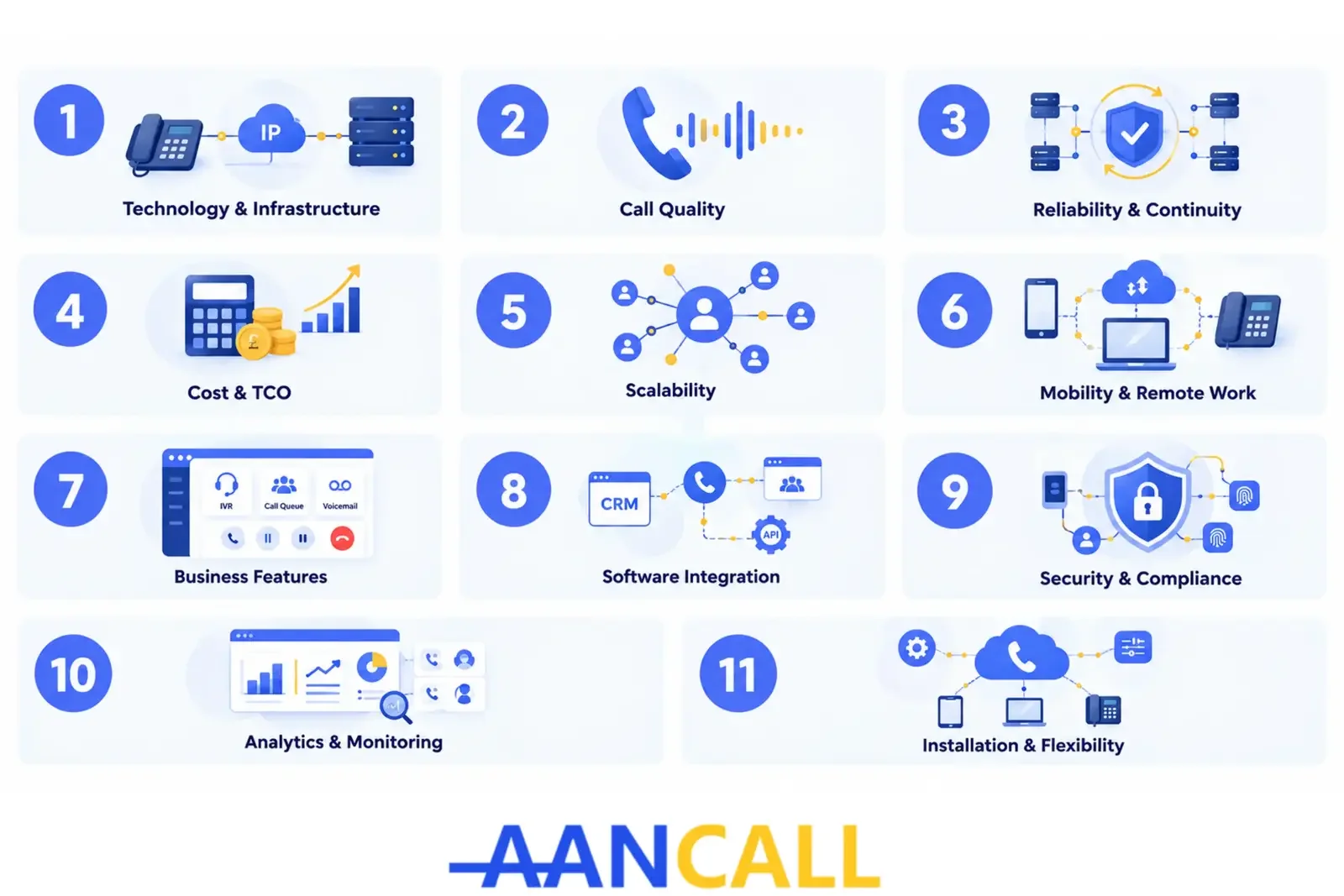
The VoIP vs landline pros and cons become clearer when both systems are compared across practical business requirements. Here are the 11 key differences UK enterprises should evaluate.
3.1 Technology and Call Infrastructure
Traditional landline: A traditional landline uses fixed telephone infrastructure and physical connections. Historically, these services relied on legacy telephone networks and dedicated lines.
VoIP: VoIP technology sends voice data across IP networks. Hosted and cloud platforms can route calls digitally through internet-connected infrastructure.
What it means for enterprises: The infrastructure affects how easily a company can expand. Traditional systems may require physical changes when adding users or locations. In contrast, IP telephony can support software-based configuration and centralised administration.
Therefore, enterprises can manage numbers, extensions, and call routing more flexibly with a suitable VoIP platform.
3.2 Call Quality and Voice Performance
Traditional landline: Fixed telephone networks have traditionally provided consistent voice quality. However, performance can still vary with infrastructure and service conditions.
VoIP: VoIP call quality depends heavily on internet performance. Latency, jitter, packet loss, and insufficient bandwidth can affect conversations.
What it means for enterprises: The VoIP vs landline call quality comparison depends on network design. A well-configured business VoIP system can deliver clear voice performance. However, poor connectivity can create delays or audio interruptions.
Enterprises should therefore consider Quality of Service (QoS), bandwidth, network monitoring, and connectivity redundancy.
For example, prioritising voice traffic can help protect VoIP voice quality when employees use the network for other applications.
3.3 Reliability and Business Continuity
Traditional landline: Fixed lines do not depend on the business internet connection in the same way. However, physical network faults can still interrupt service.
VoIP: VoIP depends on connectivity, power, provider infrastructure, and network configuration. However, enterprises can build redundancy around these dependencies.
What it means for enterprises: So, is VoIP reliable for business? It can be, when the organisation designs the system for resilience.
Useful measures include:
Primary and secondary internet connections
Automatic call failover
Cloud-hosted numbers
Mobile or softphone backup
Call forwarding
Disaster recovery procedures
Redundant provider infrastructure
For example, a company could use primary fibre alongside broadband or 5G. If the fibre connection fails, VoIP calls can automatically route through the backup connection.
Therefore, VoIP reliability depends on architecture rather than the technology alone.
3.4 Cost and Total Cost of Ownership
Traditional landline: Costs can include installation, physical hardware, line rental, calling charges, maintenance, and infrastructure changes. International calling can also add to ongoing expenses.
VoIP: VoIP cost often follows a subscription-based model. However, businesses may still pay for devices, licences, implementation, support, and network improvements.
What it means for enterprises: Businesses should compare Total Cost of Ownership (TCO), rather than monthly phone bills alone.
For example, a 50-user company might compare:
Number and user licences
IP phone costs
Installation and migration
Internet upgrades
Support fees
International calling
Hardware replacement
Future expansion
A 100-user business with multiple offices may also reduce physical infrastructure requirements through centralised cloud management.
Therefore, one of the major benefits of VoIP can be lower infrastructure complexity. However, actual savings depend on usage, provider pricing, and implementation.
3.5 Scalability for Growing Enterprises
Traditional landline: Adding users often involves additional lines, extensions, equipment, or physical configuration. Larger deployments can therefore require more planning.
VoIP: A scalable phone system can add users and extensions through software-based administration. Depending on the provider, administrators can also create departments and routing rules centrally.
What it means for enterprises: Scalability is one of the key advantages of VoIP for business.
Imagine a company opening five new offices. Instead of redesigning its entire telephone infrastructure, the organisation could provision numbers and extensions through its VoIP platform.
Likewise, businesses can add temporary users, remove inactive accounts, and support distributed teams more easily.
As a result, enterprise VoIP can align the phone system with changing organisational structures.
3.6 Mobility and Remote Working
Traditional landline: Traditional fixed systems usually associate telephone service with a specific physical location and handset.
VoIP: Business VoIP can allow employees to access calling services through desk phones, laptops, smartphones, softphones, or web applications.
What it means for enterprises: Employees can potentially maintain their business calling functionality outside the office. This supports hybrid teams, travelling employees, and distributed operations.
For example, a salesperson could use a business number through a smartphone application. A remote employee could also answer calls through a laptop softphone.
However, users still need suitable connectivity and secure access. Therefore, VoIP for remote workers works best when mobility forms part of the provider's design.
3.7 Features and Business Communication Tools
Traditional landline: Basic calling, voicemail, and forwarding may be available. However, advanced functions often require separate systems or additional infrastructure.
VoIP: Modern business VoIP platforms can combine calling with routing, automation, analytics, and collaboration features.
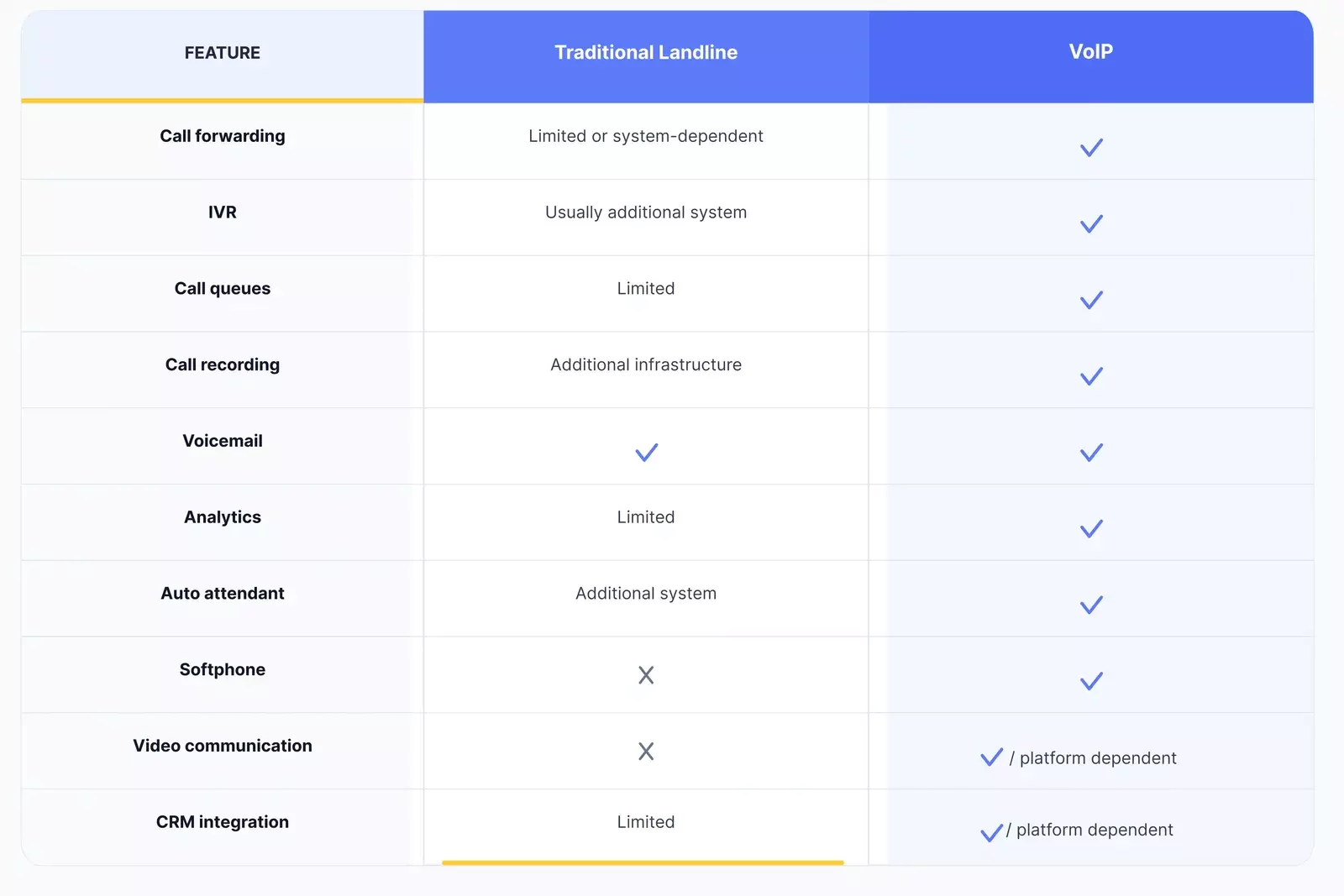
What it means for enterprises: These business VoIP features can reduce the need for separate communication tools. Moreover, capabilities vary by provider and subscription plan.
Therefore, enterprises should evaluate the exact feature set before choosing a platform.
3.8 CRM, Microsoft Teams and Business Software Integration
Traditional landline: Traditional systems can integrate with software, but integration often requires additional technology or specialist solutions.
VoIP: Modern platforms can connect with CRM systems, helpdesk software, Microsoft Teams, contact centres, APIs, and analytics tools.
What it means for enterprises: VoIP can become part of a wider unified communications environment.
For example, a sales representative receives a customer call. The CRM could identify the number and display the customer's record automatically.
Likewise, businesses can connect calling data with customer service workflows. This makes VoIP business integration particularly useful for sales and support teams.
However, integration capabilities vary between providers. Enterprises should therefore check supported applications, APIs, security controls, and licensing requirements.
3.9 Security and Compliance
Traditional landline: Traditional telephone systems are not automatically risk-free. Physical access, fraud, equipment security, and internal controls still require attention.
VoIP: VoIP security requires protection across the network, applications, devices, and administration layer.
Enterprises should consider:
Encryption
Strong authentication
Access controls
Fraud prevention
Network segmentation
Security monitoring
Software updates
Administrator permissions
What it means for enterprises: Secure VoIP depends on both provider controls and internal security practices.
Compliance requirements can also vary by industry. For example, organisations handling customer information, payment data, or recorded calls may face additional requirements.
Therefore, businesses should assess enterprise VoIP security alongside their own policies and regulatory obligations. Neither technology should be treated as automatically secure.
3.10 Management, Monitoring and Analytics
Traditional landline: Traditional systems can provide basic usage information. However, advanced reporting may require separate equipment or software.
VoIP: Cloud platforms can provide detailed VoIP analytics through centralised dashboards.
Depending on the provider, administrators may monitor:
Call volumes
Missed calls
Answer rates
Call duration
Agent performance
Peak calling periods
Number usage
What it means for enterprises: These insights can support sales, customer service, contact centre, and operations teams.
For example, a customer service manager could identify peak calling periods. The business could then adjust staffing accordingly.
Consequently, business call analytics can turn phone activity into useful operational data.
3.11 Installation, Maintenance and Long-Term Flexibility
Traditional landline: Traditional systems often involve physical infrastructure, hardware maintenance, on-site configuration, and legacy equipment considerations.
VoIP: Cloud phone systems can provide remote administration and software-based configuration. Providers may also manage much of the underlying infrastructure.
What it means for enterprises: VoIP can offer greater flexibility when businesses change locations, devices, or working arrangements. Administrators can often modify users and call flows without visiting every office.
However, there are also VoIP advantages and disadvantages to consider. Internet dependency, network configuration, cybersecurity, provider dependency, and implementation complexity can create challenges.
4. VoIP Advantages and Disadvantages for UK Enterprises
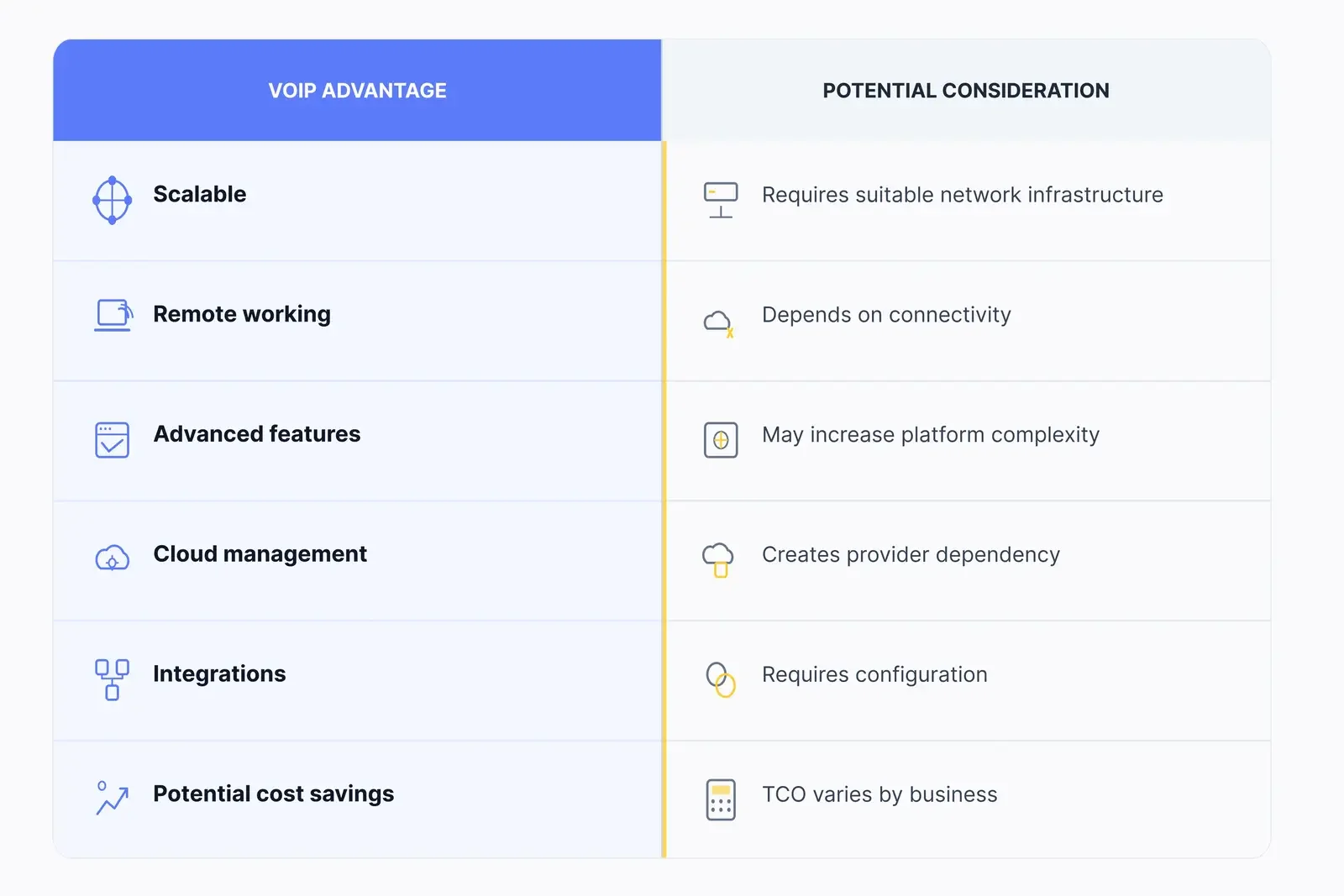
The advantages of VoIP for business go beyond cheaper calling. For UK enterprises, VoIP can support growth, flexible working, and centralised communication. However, the technology also introduces new dependencies and management requirements.
Therefore, businesses should assess both sides before switching. The right choice depends on network readiness, operational needs, and long-term communication goals.
4.1 Key Advantages of VoIP
The main benefits of VoIP come from its flexibility and software-based architecture. Businesses can add users, support multiple locations, and manage phone services centrally.
Moreover, employees can use business numbers from offices, homes, or mobile devices. Advanced features can also connect calling with CRM systems, analytics, contact centres, and collaboration tools.
For growing enterprises, this can simplify communication across different teams and locations. Likewise, cloud management can reduce the need for on-site phone system administration.
VoIP can also support disaster recovery through call forwarding, failover, and alternative devices. Additionally, centralised analytics can help managers understand calling patterns and team performance.
However, potential cost efficiencies depend on the complete Total Cost of Ownership. Therefore, businesses should compare licensing, devices, connectivity, support, migration, and calling costs.
4.2 Potential Disadvantages of VoIP
The VoIP advantages and disadvantages depend heavily on how the system is implemented. Internet dependency remains one of the main considerations.
Poor bandwidth, network congestion, or weak configuration can affect call quality. Similarly, businesses must address security risks through authentication, monitoring, access controls, and fraud prevention.
Migration can also require planning, staff training, number porting, and system configuration. Furthermore, enterprises may become dependent on their chosen provider for support and service availability.
5. Is VoIP Reliable for Business? 5 Factors That Determine Reliability
So, is VoIP reliable for business? Yes, it can be highly reliable when businesses design and manage the deployment correctly. However, reliability depends on several connected factors.
5.1 Internet Connection Quality
A reliable VoIP system needs a stable internet connection. Therefore, enterprises should monitor:
Bandwidth: Enough capacity for simultaneous calls and other applications.
Latency: Low delay helps conversations feel natural.
Jitter: Consistent packet timing reduces audio distortion.
Packet loss: Lost data can cause gaps or dropped audio.
5.2 Network Redundancy
A single internet connection creates a potential point of failure. Consequently, enterprises can add a secondary connection for resilience.
For example, a business could combine fibre with broadband or 4G/5G backup. Automatic failover can then redirect traffic when the primary connection fails.
5.3 Quality of Service
Quality of Service (QoS) helps prioritise voice traffic across the business network. As a result, calls can receive priority during periods of heavy network usage.
Enterprises should configure routers, switches, and firewalls correctly. This approach can help protect VoIP reliability when employees use bandwidth-intensive applications.
5.4 VoIP Provider Infrastructure
Provider infrastructure also affects reliable VoIP performance. Enterprises should assess data centre resilience, network redundancy, monitoring, service availability, and technical support.
Additionally, businesses should review the provider's service-level commitments. Strong infrastructure can reduce the impact of individual equipment or network failures.
5.5 Business Continuity Configuration
Finally, enterprises should prepare for unexpected disruptions. Features such as call forwarding, mobile failover, disaster recovery, and geographic redundancy can keep communications available.
For example, calls can automatically route to mobile devices during an office outage. Cloud-based numbers can also support continuity across different locations.
6. Which Businesses Can Benefit From VoIP?
The benefits of VoIP can apply to many organizations, especially those with distributed teams or complex communication needs. However, the advantages of VoIP for business become more noticeable when companies need flexibility, integration, and centralized control.
6.1 Multi-Location Enterprises
Businesses with several offices can manage numbers, extensions, and call routing from one platform. Therefore, VoIP for enterprises can simplify communication across different locations.
For example, a hypothetical UK company with 150 employees across three offices could manage its phone system centrally. New users and extensions could then be configured without rebuilding each office's telephone infrastructure.
6.2 Sales Teams
Sales teams can connect business VoIP with CRM platforms and sales tools. Consequently, features such as click-to-call, call tracking, caller information, and analytics can support daily workflows.
6.3 Customer Service Teams
Customer service departments can use call queues, IVR, and intelligent routing to manage incoming calls. Additionally, call recording can support training and quality monitoring, subject to applicable requirements.
6.4 Hybrid and Remote Organizations
Softphones and mobile applications allow employees to use business numbers from different locations. As a result, hybrid teams can maintain consistent calling workflows without relying on one office.
6.5 International Businesses
International companies can manage numbers, users, extensions, and routing across multiple countries. Moreover, centralized administration can make distributed communication easier to control.
7. How to Evaluate VoIP Providers for an Enterprise
Choosing an enterprise VoIP provider requires more than comparing monthly prices. Instead, enterprises should assess reliability, security, integrations, and long-term scalability.
A practical choosing VoIP provider checklist should include:
UK number availability and number porting
Service availability, uptime, and SLA commitments
Call quality and network architecture
Security controls and encryption
Disaster recovery and failover capabilities
Customer support and escalation processes
CRM integrations and Microsoft Teams compatibility
Call analytics and recording capabilities
User and location scalability
Pricing structure and contract terms
Data handling and storage practices
Emergency calling capabilities
Additionally, enterprises should ask how each VoIP provider UK supports business continuity. A low-cost service may not meet the requirements of a large organisation.
7.1 Enterprise Buyer Question
One question deserves particular attention:
“What happens to our business calls if our primary internet connection fails?”
A strong business VoIP provider should explain its failover process clearly. For example, calls might route through a secondary connection, mobile network, or alternative location.
Therefore, buyers should evaluate resilience alongside headline pricing. They should also test recovery procedures before deployment.
8. What Should UK Enterprises Consider Before Switching to VoIP?
A successful VoIP migration needs more than choosing a new phone provider. Instead, enterprises should follow a structured business phone system migration plan.
Start by auditing current phone lines, hardware, numbers, and legacy devices. Next, identify user requirements, calling volumes, locations, and essential features. Then, assess internet bandwidth, latency, jitter, and network resilience.
After that, compare providers based on reliability, security, integrations, support, and pricing. Meanwhile, plan number porting carefully to reduce disruption. Configure security controls and backup connectivity before testing the system.
A practical VoIP implementation can follow these steps:
Audit existing phone infrastructure.
Identify business requirements.
Assess internet and network performance.
Compare suitable providers.
Plan number porting.
Configure security and failover.
Pilot the system with selected users.
Train employees.
Complete the migration.
Monitor call quality and performance.
However, businesses should also avoid common mistakes. These include:
Choosing purely on price
Ignoring network capacity
Skipping call-quality testing
Forgetting legacy devices
Poor number-porting planning
Operating without backup connectivity
Failing to train employees
Therefore, enterprises should address potential VoIP disadvantages before switching to VoIP. A controlled migration reduces disruption and creates a stronger foundation for long-term business communications.
9. The Future of Enterprise Business Communications
The future of VoIP is moving beyond basic voice calling. Instead, enterprise communications are becoming more connected, automated, and data-driven. While many capabilities already exist, others represent emerging possibilities for business communication technology.
9.1 AI-Powered Calling
AI VoIP already supports features such as call transcription and summaries. Additionally, platforms can analyse context, identify conversation patterns, and automate quality monitoring. In the future, these capabilities could become more deeply integrated into everyday workflows.
9.2 Unified Communications
Unified communications brings voice, video, messaging, and collaboration into connected platforms. Consequently, employees can move between communication channels more easily.
9.3 Contact Centre Integration
VoIP increasingly connects with customer-experience and contact-centre platforms. Therefore, businesses can combine calling with customer records, routing, analytics, and service workflows.
9.4 API-Based Communications
With communication APIs, businesses can embed voice capabilities directly into their software. For example, a CRM could trigger calls without requiring a separate phone application.
9.5 Advanced Analytics and Flexible Workforces
Cloud communications can provide deeper operational insights than basic call records. Moreover, distributed teams can use the same communication tools across offices, homes, and countries.
Looking ahead, the future of VoIP could bring greater automation and integration. However, adoption will depend on business needs, technology maturity, security, and implementation costs.
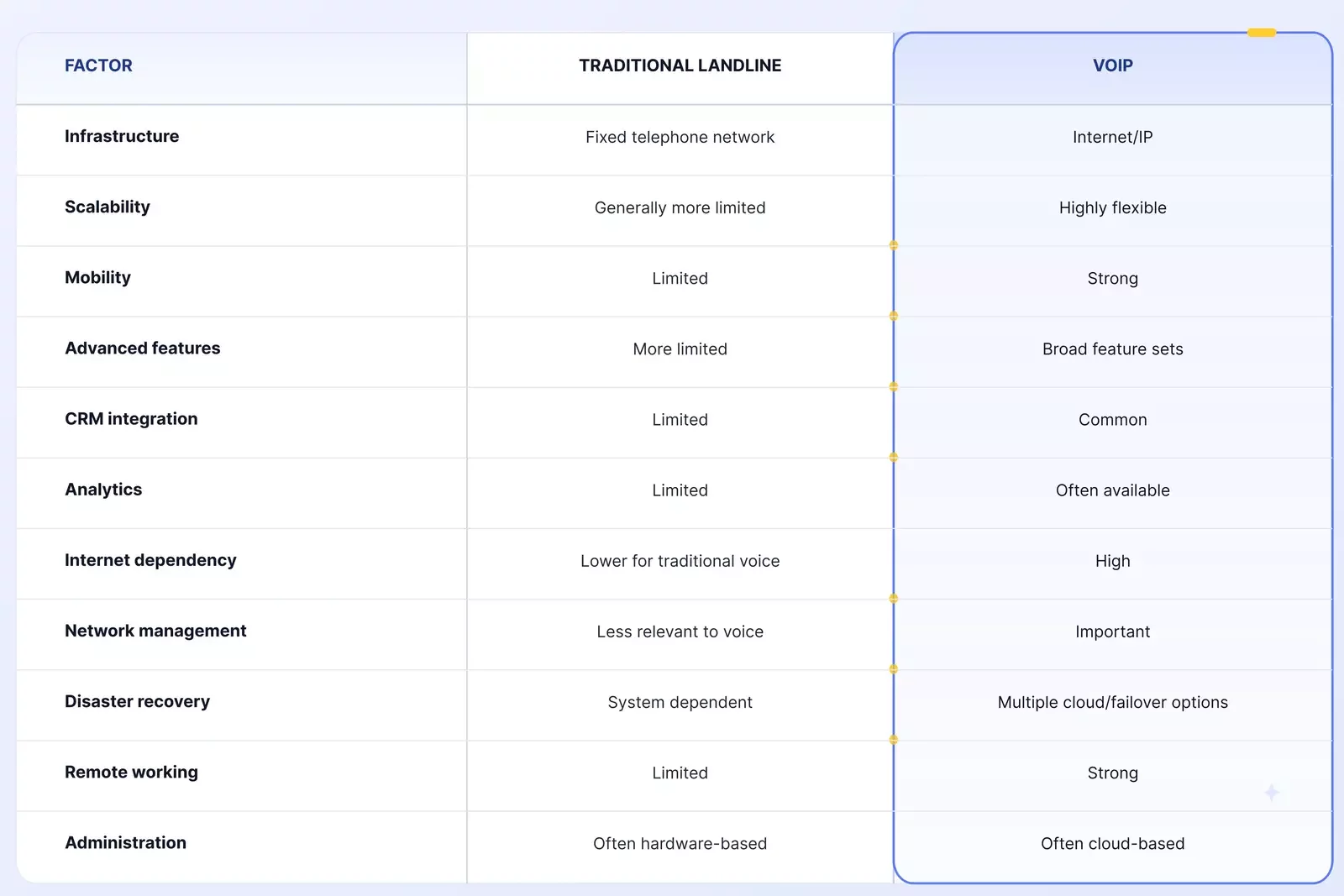
10. VoIP vs Traditional Landline: Quick Comparison
Conclusion
Understanding the VoIP vs landline pros and cons starts with recognising their different foundations. Traditional landlines rely on conventional fixed telephone infrastructure. In contrast, VoIP uses IP networks and supports broader business communication functions.
The advantages of VoIP include scalability, mobility, integrations, and centralised management. Additionally, the benefits of VoIP can extend to analytics, remote working, and advanced calling features. However, VoIP for business depends heavily on connectivity, network design, and provider infrastructure.
Therefore, enterprises should assess reliability, security, total cost of ownership, scalability, and business continuity. Looking only at monthly pricing can overlook important operational factors.
Ultimately, the right enterprise phone system depends on the organisation's operational requirements, existing infrastructure and communication priorities.
Review Your Business Phone System
FAQs
Latest from the Blog
Practical insights, guides, and strategies for modern business communication.
View All Blogs→
How UK Calling Codes Work: A Complete Guide for International Callers
Learn how UK calling codes work, including +44, geographic area codes, mobile numbers, international dialing formats, and common UK phone number mistakes.

How To Get a UK Number for WhatsApp? A Complete Guide
Learn how to get a UK Number for WhatsApp, compare SIMs and virtual numbers, avoid free-number risks, and choose a reliable business option.


