














When international businesses start serving customers in Germany, one challenge often comes up: how can customers contact the company easily without a dedicated local telephone setup? A German Virtual Number offers a practical way to address this challenge. It allows businesses to establish a German telephone contact point and route incoming calls to supported devices or existing teams.
For example, a UK-based software company can use a German number to handle sales enquiries while its sales team works remotely. Similarly, an e-commerce business can direct customer support calls to the right department without requiring everyone to work from one office.
However, choosing the right number matters. International businesses can use different numbering options, including local, national, mobile, and toll-free numbers. Each serves a different purpose, so understanding their differences helps you make a more informed decision.
Moreover, cloud-based call management can simplify call forwarding, voicemail, and team coordination. However, availability, eligibility, and features depend on the provider and number type.
Buy a German Virtual Number
Establish a local presence in Germany and make it easier for customers to reach your business. Choose a number that fits your communication needs.
1. What Is a German Virtual Number?
A German virtual phone number is a telephone number within Germany’s numbering plan that allows businesses to receive calls through virtual or hosted telephony services. Unlike a traditional landline connected to office equipment, a Germany virtual number can route incoming calls to supported devices and business phone systems without requiring a dedicated physical line at your office.
For example, employees can answer business calls using mobile phones, desktop applications, or compatible cloud phone systems. As a result, international companies can serve German customers while their sales and support teams work remotely across different countries.
Consider a US-based software company expanding into Germany. With a German virtual number, it can receive enquiries from German customers and forward them to its international sales team. Meanwhile, customer support calls can reach the appropriate department through the provider’s available routing features.
However, the phone number and the cloud telephony platform serve different purposes. The number gives customers a local contact point, while the platform manages call routing and other communication features.
Depending on the provider, a virtual phone number in Germany may support call forwarding, voicemail, business hours, and team-based routing. Therefore, check the available features before choosing a solution for your business.
Get Connected with German Customers
Reach customers across Germany with a suitable business phone number. Explore available options for your sales and support teams.
2. How Virtual Business Phone Numbers Have Evolved
To understand this evolution, I have separate the telephone number from the technology that handles calls. Germany’s numbering plan defines number categories, such as geographic, mobile, 032 national subscriber, and 0800 toll free numbers. However, the term virtual describes how a number is provided or managed, not one specific number category.
Traditionally, businesses connect telephone numbers to physical lines and on-site PBX equipment. Later, hosted PBX services moved call management to provider-hosted infrastructure. Meanwhile, cloud telephony enabled teams to manage calls through compatible devices and applications.
Today, a virtual phone system can route incoming calls to sales or support teams across different locations. For example, a company can use a German geographic number with cloud software to connect local callers to international employees. Therefore, the number defines the customer’s contact point, while the system controls call routing and available features.
Build Your Business Presence in Germany
Make it easier for German customers to contact your team. Find a virtual number that supports your expansion plans.
3. Types of German Virtual Numbers for Businesses
Choosing the right Germany virtual number starts with understanding the different number categories available to businesses. Each category serves a different purpose, from establishing a regional presence to handling nationwide customer enquiries.
Germany’s numbering plan includes geographic numbers, mobile numbers, national subscriber numbers, and toll free numbers. However, these categories are not interchangeable. The number you choose affects how customers perceive your business and how they reach your team.
Here are the main German business number types I recommend evaluating before choosing a provider.
German Local Virtual Number
A German local virtual number is a telephone number with a geographic area code associated with a particular city or region in Germany. It allows businesses to establish a regional contact point for German customers while routing incoming calls to supported mobile phones, desktop applications, or cloud-based business phone systems.
For international businesses, a local number can make it easier to organise sales enquiries, customer support, and regional communication. For example, a US-based software company targeting German customers could use a Berlin geographic number for sales enquiries and route incoming calls to its existing international sales team. Similarly, an e-commerce business serving customers in Bavaria could consider a Munich number for customer service.
3.1 German Local Phone Numbers by City
| German city | Geographic area code | Potential business use |
|---|---|---|
| Berlin | 030 | Sales, technology companies, and nationwide business enquiries |
| Hamburg | 040 | Trade, logistics, e-commerce, and customer support |
| Munich (München) | 089 | Technology, consulting, and professional services |
| Frankfurt am Main | 069 | Financial services, B2B sales, and international business |
| Cologne (Köln) | 0221 | Retail, media, and customer service |
| Düsseldorf | 0211 | Consulting, corporate services, and regional sales |
| Stuttgart | 0711 | Automotive, engineering, and manufacturing |
| Leipzig | 0341 | Regional sales, retail, and service businesses |
| Dresden | 0351 | Technology, engineering, and professional services |
| Nuremberg (Nürnberg) | 0911 | Manufacturing, distribution, and regional support |
| Bremen | 0421 | Logistics, trade, and local customer enquiries |
| Hanover (Hannover) | 0511 | B2B services, trade fairs, and regional sales |
| Bonn | 0228 | Consulting, public-sector-related services, and customer support |
| Dortmund | 0231 | Retail, logistics, and regional business enquiries |
| Essen | 0201 | Business services, sales, and customer support |
These are examples of geographic area codes, not a guarantee that every provider currently offers a virtual number in every city. Germany's Federal Network Agency maintains official information on geographic numbering areas and their associated codes.
3.2 German National Number
Germany’s 032 national subscriber number range provides numbers that are not associated with a specific geographic area. Therefore, businesses can consider this option when they want a contact point without tying the number to one German city.
However, the term national number does not automatically apply to every non-geographic number. Before choosing a Germany virtual number for nationwide business, verify the exact number range, availability, eligibility requirements, and applicable call charges. The German Federal Network Agency provides official guidance on national subscriber numbers.
3.3 German Mobile Number
A German mobile number uses designated mobile-number ranges, including prefixes such as 015, 016, and 017. Specific allocations within these ranges determine the numbers assigned to mobile services.
Businesses may consider mobile numbers for mobile-oriented communication and services that require a genuine mobile-number identity. However, a geographic virtual number forwarded to a mobile phone remains a geographic number; forwarding does not change its category.
Before purchasing, confirm mobile number availability, SMS capabilities, verification support, and compatibility with third-party services. These features can vary by provider and number type.
3.4 German Toll-Free Number
A German toll-free number typically uses the 0800 number range. It allows customers to contact a business without paying the call charge under the applicable German rules. Instead, the business generally pays for the incoming calls and associated service.
These numbers can suit customer service departments, product enquiries, and nationwide support operations. Moreover, they provide a consistent contact point for customers across different German regions.
Before you buy a toll-free number in Germany, check the provider’s service fees, supported call origins, and international reachability. Also, confirm whether calls from mobile networks and overseas locations are supported. Consult the German Federal Network Agency’s official 0800 guidance when checking the relevant numbering requirements.
Find the Right German Phone Number
Whether you need a local, national, or toll-free number, compare the available options before making your decision.
4. Benefits of a German Virtual Number for International Businesses
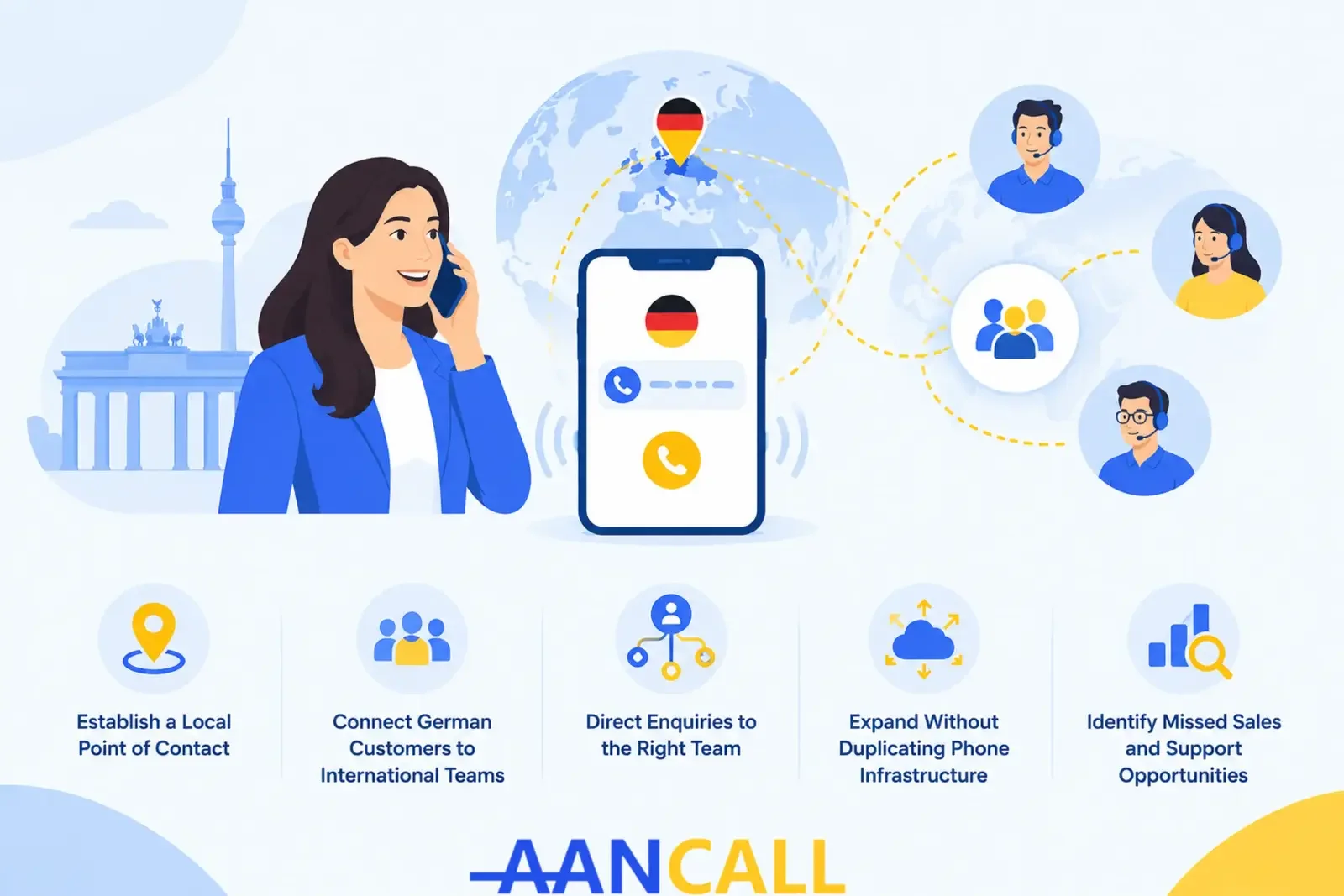
A German virtual number for business can help international companies serve German customers while managing calls across existing teams. Beyond providing a local contact number, it can improve enquiry handling, reduce communication gaps, and support expansion into the German market. Here are five ways businesses can turn virtual telephony into practical operational advantages.
4.1 Establish a Local Point of Contact
A German local number gives customers a familiar way to contact your business about products, orders, or services. For example, an online retailer targeting Berlin can provide a Berlin number for customer enquiries. This creates a dedicated contact channel for the market without necessarily requiring a physical German office. Consequently, your business can establish a local communication presence while keeping operations centralised. Geographic number eligibility and address requirements may still apply.
4.2 Connect German Customers to International Teams
A virtual phone number can route calls to employees across different countries. For instance, German customers can reach a support team in India, while complex technical enquiries go to specialists in the UK. This allows businesses to use existing staff instead of building a separate local team solely to answer calls. However, routing options depend on the provider, network availability, and applicable requirements.
4.3 Direct Enquiries to the Right Team
Sending every caller to one reception line can create unnecessary transfers and delays. Instead, businesses can use available features such as:
IVR menus: Separate sales, support, and billing enquiries.
Call queues: Manage incoming calls when agents are busy.
Business-hour routing: Direct calls according to team availability.
Call forwarding and voicemail: Help capture enquiries when employees cannot answer.
As a result, teams can spend less time redirecting calls and more time resolving customer requests
4.4 Expand Without Duplicating Phone Infrastructure
When entering new markets or adding employees, businesses can extend a compatible cloud phone system to additional users and locations. Therefore, they can manage communication centrally without necessarily installing separate physical PBX equipment at every site. This simplifies administration as operations grow.
4.5 Identify Missed Sales and Support Opportunities
Call logs and missed-call reports help managers identify unanswered enquiries and follow-up gaps. Where analytics are available, teams can review call volumes and busy periods to adjust staffing. Consequently, businesses can make more informed decisions about customer service and sales coverage.
For example, an e-commerce company can route order enquiries to customer support and wholesale enquiries to a dedicated sales queue. This helps each team prioritise relevant conversations and follow up more consistently.
Make It Easier for Customers to Call You
Give customers in Germany a convenient way to reach your business. Choose a number based on your target audience and calling requirements.
5. Which Businesses Should Consider a German Virtual Number?
A German virtual number for international businesses is useful when companies need to manage German customer conversations without building a separate local phone operation. However, each industry has different communication needs. I recommend choosing a setup that solves specific problems across sales, service, and daily operations.
5.1 SaaS Companies
SaaS companies can use a German business phone number to separate German product enquiries from other regional leads. For example, sales teams can receive demo requests while technical specialists handle onboarding questions and subscription issues. As a result, teams can assign clear ownership to each conversation and follow up with prospects throughout the sales process.
5.2 E-commerce Companies
Online retailers often receive calls about delayed deliveries, incorrect orders, returns, and refunds. A dedicated German number gives customers one contact point for resolving these issues. Moreover, businesses can route order enquiries to customer service and escalate payment or fulfilment problems to the appropriate team. This helps agents resolve issues without repeatedly transferring callers.
5.3 Consulting Businesses
Consultants need to manage discovery calls, project enquiries, and follow-ups with German prospects. A local contact number lets them separate German client conversations from other markets. Furthermore, consultants can forward calls to the relevant specialist when a prospect requests expertise in a particular service. This supports a more organised sales process without necessarily requiring a German office.
5.5 B2B Sales and Contact Centers
B2B sales teams can route German leads to account executives based on territory, product, or department. Meanwhile, contact centers can direct billing questions, technical support requests, and sales enquiries to separate queues. Where supported, call reports also help managers identify missed leads, monitor busy periods, and adjust agent coverage.
Expand Your Reach with a German Local Number
Build stronger regional connections with a geographic number suited to your target market. Check availability and applicable eligibility requirements.
6. How to Choose the Right German Virtual Number
Choosing the best German virtual number starts with understanding how customers need to contact your business. I recommend matching the number type to your target audience, calling requirements, and business model.
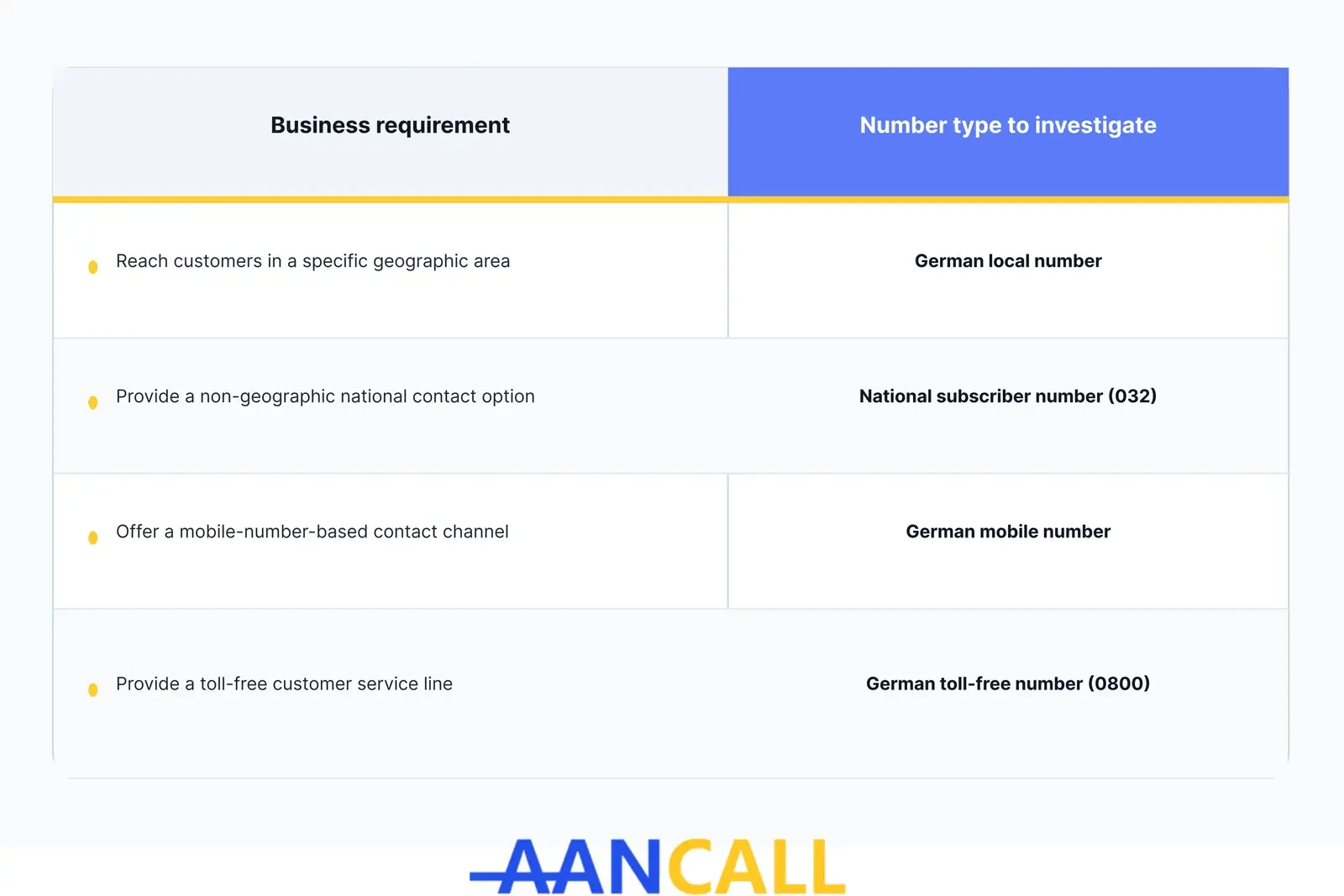
A German local vs national number comparison comes down to geographic association and intended use. Local numbers are associated with specific areas, while 032 national subscriber numbers are not tied to a particular city. Meanwhile, 0800 numbers provide a toll-free option for callers under applicable German rules. These are distinct numbering categories, so confirm availability and eligibility before choosing.
6.1 What to Check Before Purchasing
Before selecting a German toll-free number for business or another number type, confirm:
Calling capabilities: Incoming and outgoing calls, including supported destinations.
Eligibility: Required business documents and address requirements.
Pricing: Rental fees, usage charges, and any setup fees.
Portability and contracts: Number transfer options, minimum terms, and cancellation conditions.
Features and integrations: IVR, call forwarding, call queues, analytics, and compatibility with your existing systems.
Give Customers a Toll-Free Contact Option
Help customers contact your business through a German 0800 freephone number. Check the service terms and international calling availability before choosing a plan.
7. How to Buy a German Virtual Number: Step-by-Step Setup
If you want to buy a German virtual number, start by identifying your business communication needs. Follow these six steps to choose and configure the right solution.
Step 1: Define Your Requirements
First, decide which number type suits your business. Consider a local geographic number, a national subscriber number, or a toll-free number. Also, estimate your call volume, target customers, business hours, and call destinations. For example, an international SaaS company may need a German number that routes sales enquiries to its existing team.
Step 2: Check Availability and Eligibility
Next, contact providers to confirm whether they can supply your preferred number. Ask about business registration documents, address requirements, and verification procedures. Geographic numbers may have specific eligibility conditions. Therefore, confirm these details before proceeding.
Step 3: Compare Providers and Plans
Before you buy a virtual phone number, compare the complete pricing structure. Check recurring rental fees, setup charges, call rates, contract length, and cancellation policies. Additionally, review features such as call forwarding, IVR, voicemail, and call analytics. Choose a plan that matches your expected usage.
Step 4: Purchase the Number
Once you select a provider, review its available German numbers and choose a suitable option. Then, submit the required business information and complete any verification steps. Before you purchase a phone number, read the service terms carefully. Finally, follow the provider’s ordering and payment process. Requirements vary by provider, so confirm the next steps directly.
Step 5: Configure Call Routing
After the provider enables your number, direct incoming calls to supported users, devices, or existing business systems. Set business-hour rules, voicemail, and call queues where available. This setup helps your team manage German customer enquiries efficiently.
Step 6: Test and Launch
Finally, test incoming calls, routing, caller ID where supported, voicemail, and missed-call notifications. Check connectivity from relevant locations and networks. Resolve any issues before sharing the number with customers.
Simplify Your Business Call Management
Connect your German business number to supported phone systems and route incoming calls to the right team. Make customer communication easier to manage.
8. Challenges and Compliance Considerations
Before you purchase a German virtual number, review the applicable requirements and service limitations. I recommend checking both regulatory rules and your provider’s specific policies. This helps you avoid unexpected restrictions after setup.
8.1 Understand German Virtual Number Requirements
The German Federal Network Agency (Bundesnetzagentur) oversees Germany’s telecommunications numbering framework. Its guidance explains number ranges, allocation rules, and relevant conditions. Therefore, check the agency’s official information before choosing a number category.
Requirements can vary between geographic, national subscriber, mobile, and toll free numbers. Additionally, providers may request business documents or verification details. These policies do not automatically mean every international company needs a German office.
8.2 Check Geographic Eligibility and International Access
Geographic numbers may have specific requirements linked to their assigned areas. Consequently, confirm whether your business meets the applicable conditions before ordering. Also, check whether customers abroad can reach your selected number. International access may depend on the number type and the originating network.
8.3 Review Call Quality, Privacy, and Security
Call quality depends on internet connectivity, routing, and the provider’s infrastructure. Therefore, test calls from relevant locations before launch. Review how the provider stores call records, handles recordings, and protects customer information. Also, assess its privacy controls and security measures.
8.4 Confirm Emergency Calling Limitations
Finally, do not assume a virtual number supports emergency calls like a conventional fixed line. Capabilities can vary by service and configuration. Confirm emergency-calling availability, location handling, and limitations directly with your provider.
Once you understand these requirements, you can evaluate providers more confidently and choose a setup that fits your business needs.Find a German Number for Your Business Needs
Not sure which number type suits your business? Discuss your requirements and explore suitable options for customer calls in Germany.
9. How to Evaluate a German Virtual Number Provider
Choosing the right German virtual number provider involves more than comparing advertised prices. I recommend evaluating each provider against the same business requirements. This approach helps you identify the right fit for your call volume, budget, and customer communication needs.
9.1 German Virtual Number Provider: Buyer's Checklist
Before making a decision, check whether the provider offers:
Number availability: Confirm your preferred German number type and geographic eligibility.
Transparent pricing: Compare recurring fees, setup charges, and usage-based call rates.
Clear requirements: Check documentation, verification, and activation procedures.
Calling features: Verify supported destinations, call forwarding, IVR, and call queues.
Flexible terms: Review number portability, contract commitments, and cancellation policies.
Security and privacy: Understand how the provider protects customer data and handles call records.
Reliable support: Assess technical assistance, support hours, and service reliability.
System compatibility: Confirm integration with your existing business phone system and workflows.
Start Your German Business Communication Journey
Planning to enter the German market? Explore AANCALL’s available number options and find a solution that aligns with your customer communication goals.
10. Why Consider AANCALL for German Business Numbers?
When expanding into Germany, I recommend choosing a business number that matches your customers’ needs. AANCALL offers German local, national, and toll-free number options for businesses seeking to establish a telephone presence in the market.
Conclusion
Choosing the right German virtual number can help your business connect with customers across Germany. Moreover, you can manage calls through supported virtual or hosted telephony services without relying solely on traditional phone systems.
However, the best option depends on your goals. A local number supports regional communication, while a national number provides a non-geographic contact option. Meanwhile, an 0800 toll-free number lets customers call your business without paying the call charge. Mobile numbers serve a different purpose and require separate consideration.
FAQs
Latest from the Blog
Practical insights, guides, and strategies for modern business communication.
View All Blogs→
Learn how to get UAE virtual numbers for business calls, compare number types, understand eligibility and VoIP regulations, and choose the right provider for your business needs.
Looking for a SIP trunk for your AI voice agent or voicebot? Learn how BYOT works with Cognigy, ElevenLabs, Pinkfish, Vapi, Retell, LiveKit and more, plus how to pick DIDs, channels, calling strategy and low per-minute rates.


