















When I look at how businesses expand into the UAE, I see one common challenge: staying connected with customers across the Emirates. Setting up a traditional phone system can involve extra infrastructure, higher costs and complex management across locations. That's why I consider UAE virtual numbers for business a practical alternative for companies that want to manage calls through supported cloud-based telephone systems.
Whether you're running an international sales team, an e-commerce business or a customer support department, the right virtual number can help you organise incoming calls. It can also help your team manage customer conversations across different locations, depending on the service you choose.
However, I wouldn't recommend choosing a provider based on price alone. You also need to understand number types, eligibility requirements, calling features and potential costs. More importantly, the UAE regulates VoIP services, so I always recommend verifying that your chosen calling arrangement meets the applicable requirements.
In this guide, I'll walk you through how to get UAE virtual numbers for business, which documents you may need and how to configure your phone system. I'll also explain what to compare and how to choose a provider that fits your business needs.
Build a Local Presence in the UAE
Connect with customers across the UAE using a local business number and manage calls through your business phone system.
1. What Are UAE Virtual Numbers for Business?
When I explain UAE virtual numbers for business, I describe them as telephone numbers that let companies manage calls without relying on one physical phone line. Instead, businesses can route incoming calls to supported mobile phones, computers, cloud PBX systems or contact centres.
Unlike a traditional landline, a UAE virtual phone number doesn't necessarily depend on a physical connection at your office. Similarly, it differs from a mobile SIM because you may use it through a compatible cloud-based calling service. However, available features depend on the provider and number type.
For example, I might recommend a UAE business phone number to a company serving customers in Dubai while its sales team works from different locations. The team can manage calls through a supported system without everyone needing a separate office landline.
It's also important to understand three distinct concepts:
Virtual phone number: The telephone number customers dial to reach your business.
VoIP technology: The technology that carries voice calls over internet protocol networks.
Cloud phone system: The platform that manages calls, extensions, routing and other business features.
2. Types of UAE Virtual Numbers Businesses Can Choose
When choosing UAE virtual numbers for business, I recommend starting with your audience and calling needs. Different number types serve different purposes, and availability depends on the provider and applicable UAE requirements.
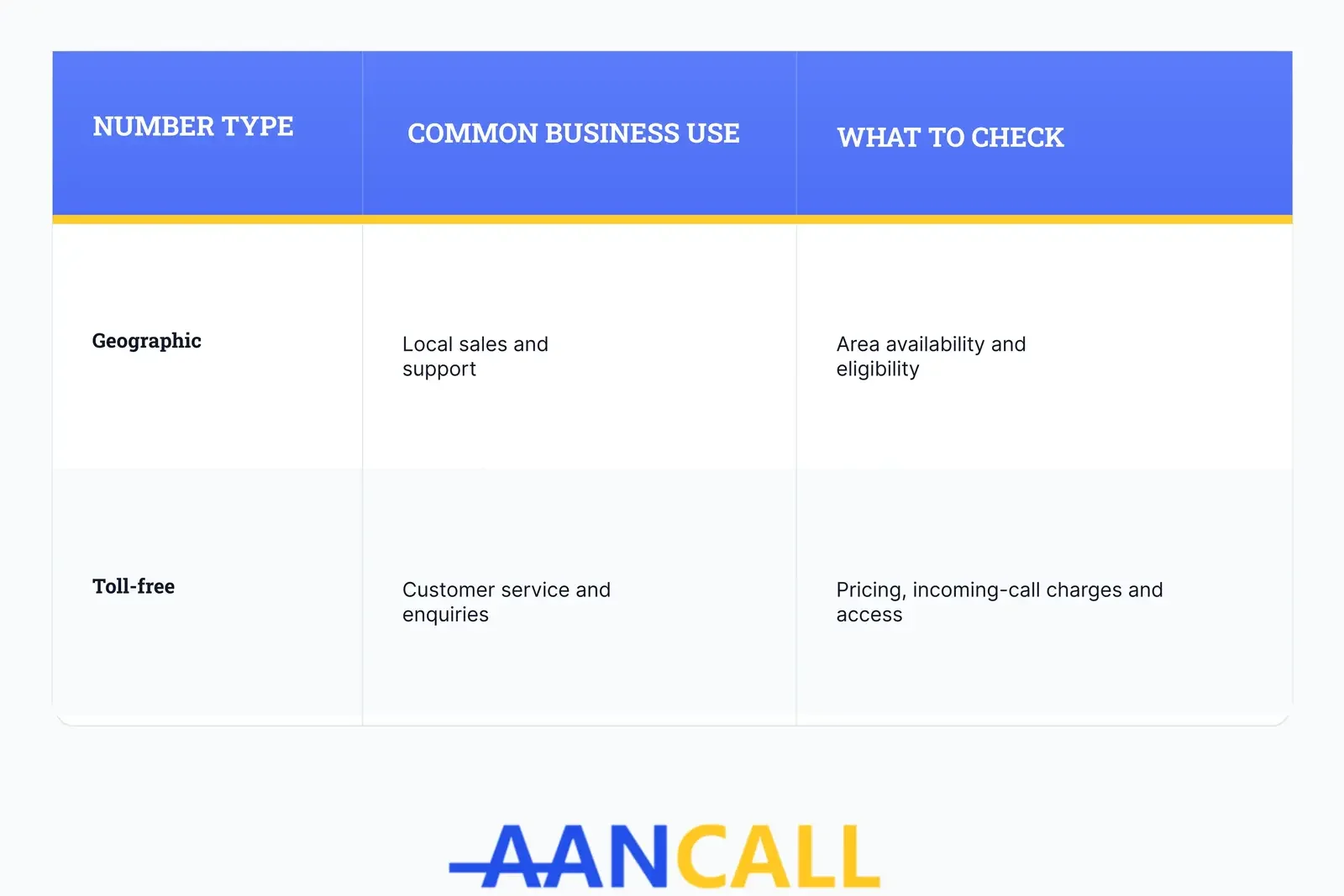
2.1 Geographic Numbers
A Dubai virtual number can help businesses establish a local presence in Dubai. Similarly, Abu Dhabi numbers can support companies serving customers in the capital. For example, Dubai's geographic area code is 04 domestically and +971 4 internationally. Abu Dhabi uses 02 domestically and +971 2 internationally.
Therefore, a UAE geographic phone number can help customers recognise the region your business serves. However, confirm whether your provider offers the required number and what eligibility rules apply.
2.2 Toll-Free Numbers
Make It Easier for Customers to Reach You
Give customers a toll-free number to contact your business without paying for calls to that number.
3. Why Businesses Use UAE Virtual Numbers
When I evaluate business phone systems, I look at how well they support customer communication and daily operations. A UAE virtual number for business calls can help companies manage conversations across locations without relying on one office phone line.
For example, an international software company might receive enquiries from customers in Dubai, Abu Dhabi and other Emirates. Instead of managing separate phone lines at each location, the company could route calls through a central cloud phone system. Sales enquiries would reach the sales team, while technical issues would go to customer support.
Moreover, cloud-based calling can help distributed teams answer calls through supported devices and applications. Managers can also use centralised call management features to configure routing, extensions and business hours. As a result, teams can follow consistent processes even when employees work remotely.
A UAE phone number for international business can also provide a regional contact point for customers. Depending on the platform, businesses may integrate calling with CRM software or contact-centre tools. These integrations can help teams access customer records, track interactions and coordinate follow-ups.
However, the benefits depend on the provider, system configuration and business needs. I recommend checking call routing, reporting, integrations and number eligibility before committing.
Get Connected with UAE Customers
Build stronger customer relationships with a UAE virtual number that helps your business manage calls through a cloud-based phone system.
4. How to Get UAE Virtual Numbers for Business Calls
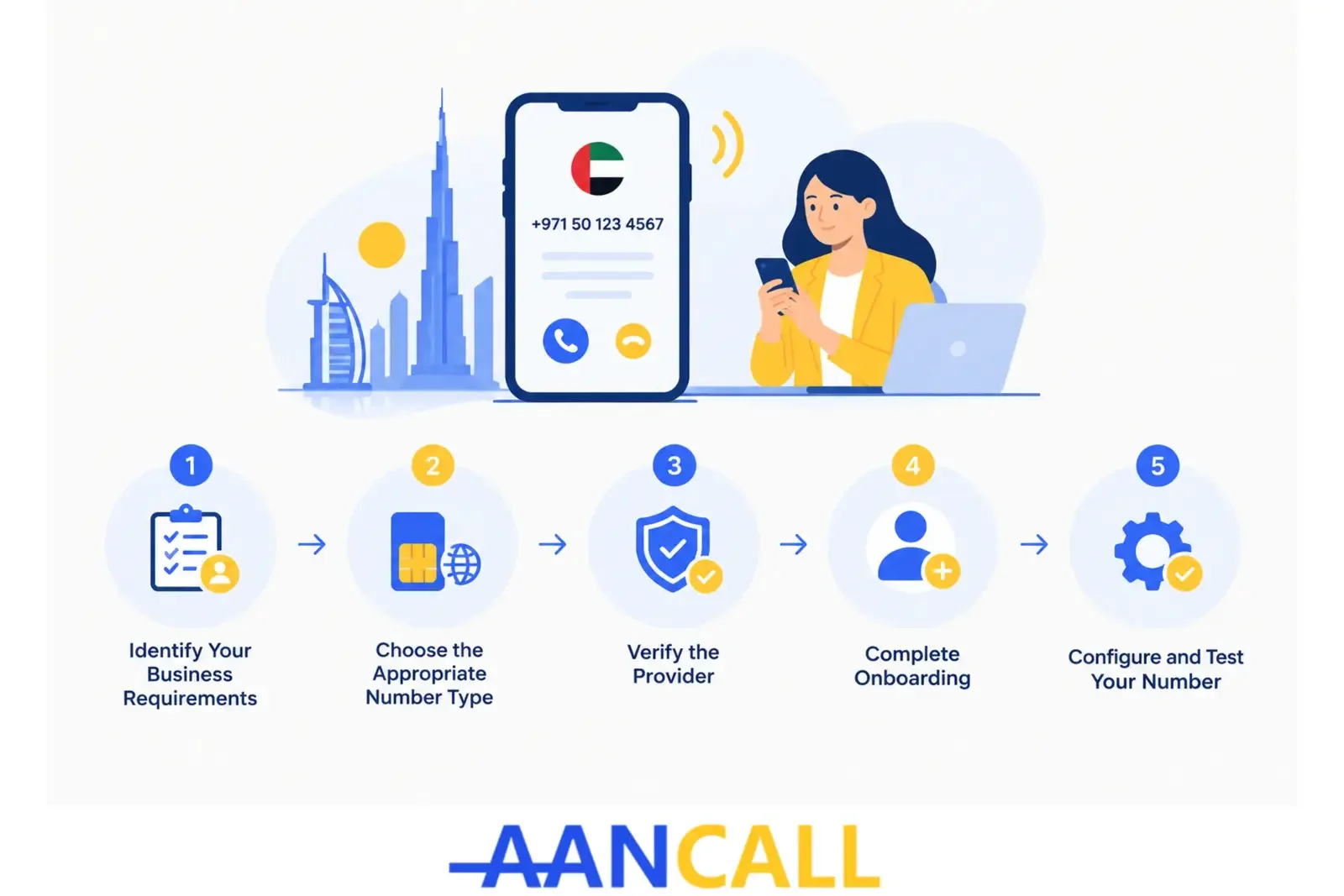
If you're researching how to get a UAE virtual number, I recommend following a clear process rather than choosing the first provider you find. Your number type, calling requirements and eligibility can all affect your options. Here's how I would approach the process.
Step 1 — Identify Your Business Requirements
First, decide how your business will use the number. Do you need incoming calls, outgoing calls or both? Alternatively, you might need call forwarding, team extensions or a complete contact-centre solution.
Also, consider your expected call volume, working hours and required integrations. These details will help you compare providers more effectively.
Step 2 — Choose the Appropriate Number Type
Next, decide whether a geographic or toll-free number suits your audience. For example, a company serving customers in Dubai might prefer a Dubai geographic number, if available and eligible.
However, number availability and registration rules vary. Therefore, confirm your preferred number type before proceeding to checkout.
Step 3 — Verify the Provider
Before you buy a UAE virtual number for business, investigate how the provider delivers its service. Check its authorisation arrangements, relationship with licensed UAE telecommunications operators and support for your intended calling setup.
The UAE regulates internet-based voice services. Therefore, don't assume every provider or calling configuration is automatically permitted. Review the TDRA Internet Guidelines and ask the provider about applicable requirements.
Step 4 — Complete Onboarding
Once you've shortlisted a suitable provider, follow its application and identity-verification process. Depending on your location, number type and service, you may need business registration details, identification documents or other supporting information.
If you're applying from outside the UAE, confirm the requirements before paying. This helps you avoid delays caused by incomplete documentation or eligibility issues.
Step 5 — Configure and Test Your Number
After approval, configure your number using the provider's supported features. These may include call forwarding, team extensions, voicemail and business hours.
Before deployment, test incoming and outgoing calls, caller ID, audio quality and billing. Also, verify that calls reach the correct teams and that your setup works across supported devices.
Take Your Business Communications Online
Move beyond traditional phone systems with a UAE virtual number that supports flexible business calling.
5. Documents and Eligibility Requirements
Before applying for a UAE virtual number, I recommend checking the provider's eligibility rules and onboarding requirements. The documents you need can vary depending on your location, business structure, number type and intended use.
As part of the application, a provider may request the following UAE business phone number documents:
Company registration documents: To verify your business's legal identity.
Trade or business licence: Where the provider or applicable requirements call for one.
Proof of business address: To confirm your registered or operating location.
Authorised representative's identification: To verify the person submitting the application.
Additional verification information: Such as business contact details or supporting records, where applicable.
However, these documents are not universal requirements for every customer. Providers may apply different checks based on their service arrangements and the number they offer.
5.1 Can Foreign Companies Get a UAE Virtual Number?
Some providers may offer UAE-number solutions to businesses established outside the country. However, availability should not be interpreted as a guarantee that every foreign company can obtain every type of UAE number or use it with any calling platform.
Eligibility can depend on the number category, the provider's arrangements with authorised telecommunications operators, registration and documentation requirements, and the intended use of the service.
Give Your Support Team a Better Call Channel
Route customer enquiries through a UAE toll-free number and manage incoming conversations with your supported telephony tools.
6. UAE Virtual Number Rules, VoIP Regulations and Compliance
Before choosing a UAE virtual number, I recommend understanding the rules governing business calls. The UAE regulates telecommunications services, so businesses should verify their provider and intended calling setup.
6.1 Is VoIP Allowed in the UAE?
VoIP services are regulated in the United Arab Emirates. According to the Telecommunications and Digital Government Regulatory Authority (TDRA), VoIP services serving users in the UAE must be provided by licensed telecommunications service providers, in collaboration with them, or under applicable TDRA approval.
This means businesses should not assume that every internet-based calling application, overseas virtual-number provider or cloud telephony configuration is permitted for use in the UAE.
Before purchasing a UAE virtual number, verify how the provider delivers the service, whether the relevant UAE telecommunications authorisation requirements are met, and whether your intended inbound and outbound calling arrangements are supported. Review the official TDRA Internet Guidelines for further information.
Important: Having a UAE telephone number does not, by itself, establish that the associated VoIP service or calling arrangement is authorised.
6.2 Do Businesses Need a Telecommunications Licence?
A business purchasing telephone services for its own operations is not necessarily subject to the same licensing obligations as a company providing or reselling telecommunications services. The applicable requirements depend on the activity, the service model and the relevant UAE authorisations.
The TDRA states that operating a public telecommunications network or providing telecommunications services to subscribers requires the appropriate licence where the activity falls within the applicable licensing requirements.
Businesses should therefore distinguish between subscribing to a business phone service and independently providing, reselling or operating a regulated telecommunications service. If a cloud telephony arrangement involves a third-party platform, SIP trunk or call-routing service, verify the relevant authorisation arrangements rather than relying solely on the provider's marketing claims.
For further information, consult the TDRA telecommunications licensing service.
6.3 What About Telemarketing Calls?
UAE Cabinet Resolution No. 56 of 2024 establishes requirements for companies conducting covered telemarketing activities. Depending on the activity, these include obtaining prior approval from the competent authority, training marketers, using eligible local telephone numbers registered under the company's commercial licence, respecting Do Not Call Registry (DNCR) restrictions, and maintaining the required records of marketing calls.
The regulations also restrict the timing of covered marketing calls. The prescribed calling window is generally 9 am to 6 pm UAE local time, subject to the applicable provisions and any relevant exceptions.
These rules should not be treated as applying identically to every business call. Telemarketing calls, ordinary customer-service calls and other business communications can have different regulatory implications.
Before using a UAE virtual number for sales campaigns, verify whether your business and calling activity fall within the regulations, whether your number meets the applicable requirements, and what approvals and records are required. Consult the official Cabinet Resolution No. 56 of 2024 before launching a campaign.
6.4 What Should Businesses Verify?
Before activating a UAE business number, I recommend checking these compliance essentials:
Provider authorisation: Confirm the provider's licensing arrangements and relationship with authorised UAE operators.
Number eligibility: Check registration requirements for your chosen number type.
Outbound calling: Verify whether your plan supports outbound calls and your intended destinations.
Caller ID: Confirm which caller ID formats your provider supports and permits.
Industry-specific rules: Check additional requirements for regulated sectors or telemarketing activities.
Reach Your UAE Audience with Confidence
Create a dedicated contact point for your UAE customers and manage business conversations through a cloud-based phone system.
7. How to Set Up and Use a UAE Virtual Number
Once you have chosen a provider, the next step is configuring your UAE virtual number setup. I recommend starting with your call flow, then adding features your team actually needs.
Follow these steps to get started:
Configure call forwarding: Route incoming calls to supported mobile phones, desktop apps or business phone systems. With business call forwarding in the UAE, your team can manage calls across different locations, subject to provider capabilities.
Create team extensions: Assign separate extensions to sales, customer support and management. This way, callers can reach the right department without dialling multiple numbers.
Set up voicemail and business hours: Record a professional greeting and route after-hours calls to voicemail or another supported destination. Meanwhile, configure business-hour rules to manage calls during working hours.
Connect your cloud phone system: Integrate your number with a compatible Cloud PBX UAE solution or contact-centre platform. If you need a UAE SIP trunk, confirm that your provider supports it through an appropriate authorised service arrangement.
Enable CRM and reporting tools: Where available, connect supported CRM software to help your team track customer interactions and review call activity.
Finally, test incoming and outgoing calls, routing rules, audio quality and caller ID before going live. Remember, available features depend on your provider, subscription and applicable regulations.
Make Business Enquiries More Convenient
Provide customers with a UAE toll-free number as an alternative contact channel for sales enquiries and customer assistance.
8. Business Use Cases for UAE Virtual Numbers
I see UAE virtual numbers serving different purposes depending on a company's customers, team structure and call volume. Here are four practical applications.
8.1 International Enterprises
For international businesses, a UAE number for international companies can provide a consistent contact point for customers across the Emirates. As a result, teams can manage calls through supported cloud phone systems without relying on one office phone.
8.2 E-commerce Businesses
Online stores can use a UAE customer support phone number to handle order updates, delivery questions and return requests. Moreover, routing rules can direct enquiries to the appropriate team, helping staff manage customer conversations more efficiently.
8.3 B2B Sales Teams
A dedicated UAE sales phone number gives potential customers a clear way to contact a business. Meanwhile, call routing can direct enquiries to sales representatives based on departments, availability or configured extensions.
8.4 Contact Centres
A UAE call centre number can support centralised call handling through compatible contact-centre infrastructure. For example, supported systems can organise call queues, distribute enquiries and connect remote agents.
Example: Centralising Customer Calls
Imagine an international software company serving customers in Dubai and Abu Dhabi. Initially, its sales and support teams handle enquiries through separate phone lines. By introducing a suitable cloud phone system, the company could route calls through one main business number and direct callers to the right department. Consequently, managers could review available call reports from one platform.
This example is illustrative and does not represent an actual customer result.
Create a Dedicated UAE Contact Channel
Give customers a clear way to contact your business while your team handles calls from its preferred location.
9. Common Challenges and How to Avoid Them
Although UAE virtual numbers can simplify business communications, I recommend checking potential issues before choosing a provider. Understanding common UAE virtual number problems can help you avoid unnecessary costs and setup delays.
Here are six challenges to consider:
Number availability: Geographic numbers may have different eligibility requirements. Therefore, confirm availability and required documents before purchasing.
Call connection failures: Some destinations may not support your chosen calling service. Check outbound permissions and applicable UAE VoIP restrictions before deployment.
Poor audio quality: Network congestion, latency and unstable internet can affect UAE business call quality. Test calls across your team's actual devices and locations.
Caller ID limitations: Some providers restrict caller ID formats or forwarding destinations. Confirm these details during setup.
Unexpected charges: International calls, forwarding and additional features may incur extra fees. Review the complete pricing terms first.
System compatibility: Your existing PBX or CRM may not support every integration. Verify compatibility before committing.
For effective UAE virtual number troubleshooting, test inbound and outbound calls, review call logs and contact provider support when issues persist.
Make Your UAE Business More Accessible
Give customers a dedicated way to reach your team with a virtual number designed for business communications.
10. Trends and Future Scope of UAE Business Telephony
I see several technology trends shaping the future of UAE cloud telephony. First, cloud PBX platforms help businesses manage calls, extensions and distributed teams through centralised systems. Meanwhile, CRM-connected communications bring customer information closer to everyday conversations.
Additionally, AI voice agents and voicebots can handle routine enquiries, answer common questions, qualify leads and route calls to the right department. Depending on the integration, they can also support appointment scheduling and customer record updates. As a result, businesses can automate repetitive tasks while keeping human agents available for complex conversations.
Call analytics can further help managers identify recurring customer concerns and review team performance. Moreover, these insights can inform decisions about staffing, call routing and service improvements.
However, businesses must evaluate each technology carefully and comply with applicable UAE telecommunications, privacy and consumer-protection rules.
Give Customers a Toll-Free Way to Call
Offer a UAE toll-free number so callers can contact your business without call charges to that number, subject to supported service arrangements.
11. Why Consider AANCALL for Business Telephony?
Before exploring AANCALL business calling solutions, make sure your company meets these requirements. Then, review the available features and contract terms to determine whether the service suits your business.
Here are four factors I recommend reviewing:
Business eligibility: Your company must be registered in the UAE and have a UAE business address to qualify for UAE virtual number.
Contract duration: UAE plans require a minimum 12-month contract. Therefore, consider your long-term requirements and budget before signing up.
Call management: Review the available features to determine whether they support your team's calling workflows and customer communication needs.
Pricing transparency: Check subscription fees, calling rates and any additional charges before selecting a plan.
Create a Central Number for Customer Calls
Bring customer enquiries into a dedicated UAE toll-free contact channel for easier call management.
Conclusion
Getting the right UAE virtual number for business calls starts with understanding your communication needs. First, choose a suitable number type for your customers and calling requirements. Then, verify provider eligibility, authorisation arrangements and available features. Additionally, compare calling costs and test the service before making a commitment.
For international businesses, a UAE virtual number can help centralise customer communication and connect sales or support teams across locations. However, number availability, outgoing calling capabilities and integration options vary by provider. Therefore, check these details to ensure the service meets your business requirements and complies with applicable UAE regulations.
Before making your decision, share yout needs with AANCALL. If your business is registered in the UAE and has a UAE business address, contact AANCALL to discuss your business telephony requirements and confirm available number options, calling features and service terms.
Create a Recognisable Business Helpline
Establish a dedicated UAE toll-free contact point to support customer enquiries and centralise incoming calls.
FAQs
Latest from the Blog
Practical insights, guides, and strategies for modern business communication.
View All Blogs→
Looking for a SIP trunk for your AI voice agent or voicebot? Learn how BYOT works with Cognigy, ElevenLabs, Pinkfish, Vapi, Retell, LiveKit and more, plus how to pick DIDs, channels, calling strategy and low per-minute rates.
Compare VoIP vs traditional landlines for UK enterprises. Explore 11 key differences, pros and cons, costs, reliability, scalability, security and features.


