














I've spent a long time in telecoms, long enough to remember when "voice automation" meant a clunky IVR that shouted "Press 1 for sales" at you. Today a caller rings a number and chats to an AI agent that sounds like a real person, understands interruptions, checks a CRM mid-sentence and books the appointment. It's remarkable.
But here's what I see over and over. A team builds a brilliant voice agent in Cognigy, ElevenLabs, Pinkfish or Vapi. The demo is flawless. Then they try to take it live on real phone numbers and hit a wall. The built-in telephony is pricey, the numbers aren't available in the country they need, the concurrency limits are too tight, or the call quality is patchy.
The fix is usually the same: Bring Your Own Telephony (BYOT) with a proper SIP trunk. This guide covers what that means, how it works with the major AI voice platforms, and how to choose a trunk that won't let your agent down at 9am on a Monday.
1. What is BYOT, and why do AI voice teams keep asking for it?
BYOT stands for Bring Your Own Telephony. You'll also see BYOC, "Bring Your Own Carrier", or BYOSIP. Instead of renting phone numbers and minutes from your AI platform, you connect your own SIP trunk to it.
Think of it like this:
- The AI platform is the brain: speech recognition, language model, text-to-speech, dialogue logic.
- The SIP trunk is the phone line: how calls get from the public phone network (PSTN) to your AI, and back out again.
When you separate the two, you get control over things your platform's default telephony often can't give you:
- Number choice: Pick exactly the DIDs you want, in the countries and area codes you want.
- Capacity control: Decide how many simultaneous calls (channels) you can handle.
- Cost control: Pay wholesale-style per-minute rates instead of platform-marked-up telephony.
- Routing control: Choose how outbound calls are routed and presented.
- Portability: Move your numbers between platforms without losing them. This matters more than people realise.
2. How a SIP Trunk Connects to Your AI Voice Agent
You don't need to be a telecom engineer, but a rough picture helps.
Inbound call: A customer dials your DID → the call travels over the PSTN → your SIP trunk provider receives it → it's delivered via SIP to your AI platform's SIP endpoint → your agent answers.
Outbound call: Your AI platform triggers a call → it sends a SIP INVITE to your trunk → your provider routes it to the destination number → the person picks up and your agent starts talking.
Most platforms ask for a handful of details:
- SIP server / domain (your provider's, or the platform's)
- Authentication: either IP-based or username/password (digest)
- Transport: UDP, TCP or TLS
- Media encryption: SRTP, where supported
- Codecs: G.711 (µ-law / A-law) is the safe default for voice AI, since it's what speech engines are tuned for
- Number format: E.164, e.g. +14155550123 or +442071234567
Once the trunk and platform trust each other, you map your numbers to agents and you're live.
3. Which AI Voice Platforms Support BYOT and SIP Trunking?
The AI voice market is expanding quickly, with platforms ranging from developer-focused voice-agent frameworks to enterprise conversational AI and no-code agent builders. Many of these platforms can connect to external telephony infrastructure through SIP, custom carriers, SIP trunks, or other telephony integrations.
However, the exact implementation differs from one platform to another. Some platforms allow you to bring your own SIP trunk directly, while others use specific telephony providers, SIP gateways, PBX connections, or enterprise integrations.
Before provisioning numbers or signing a telecom contract, always check the platform's latest documentation for supported countries, inbound and outbound calling, SIP authentication, transport protocols, codecs, concurrency limits, and regional availability.
3.1 Cognigy (Voice Gateway)
Cognigy is an enterprise-focused conversational AI platform designed for customer service, contact centers and complex voice automation. Its Voice Gateway provides the telephony layer that connects Cognigy.AI agents to phone networks through SIP interfaces.
Cognigy's documentation specifically supports connecting a phone number and SIP trunk to a Voice Gateway endpoint and configuring a carrier connection. The Voice Gateway supports SIP, RTP, SRTP and multiple audio codecs, making it suitable for enterprise telephony environments.
This makes Cognigy particularly relevant for organizations that already have an SBC, carrier relationship, PBX or contact-center infrastructure and want to add conversational AI without completely replacing their existing telephony architecture.
Best suited for: Enterprise contact centers, customer service automation, regulated organizations and large-scale voice deployments.
3.2 ElevenLabs (ElevenAgents / Conversational AI)
ElevenLabs is widely known for highly realistic AI voices, but its conversational AI platform also provides direct SIP trunking capabilities. Businesses can connect existing telephony infrastructure to ElevenLabs Agents and use their own phone numbers and SIP infrastructure for inbound and outbound calls.
ElevenLabs supports SIP authentication through credentials or IP-based access controls, and its documentation covers TCP, TLS and media encryption options. It also supports commonly used telephony codecs such as G.711 and G.722.
This makes ElevenLabs particularly attractive for businesses where natural voice quality is an important part of the customer experience while the organization still wants control over its existing phone infrastructure.
Best suited for: Customer-facing AI agents, premium voice experiences, international businesses, developers and companies that already have SIP-enabled telephony.
3.3 Vapi
Vapi is a developer-focused voice AI platform built around APIs and flexible integrations. It is particularly popular with developers, startups and technical teams that want greater control over the voice-agent stack.
Vapi provides dedicated documentation for SIP trunking and explicitly supports custom BYO SIP trunk configurations. You can provide your SIP gateway information, authentication details and external phone numbers, allowing Vapi agents to communicate with the PSTN through your chosen telephony provider.
Vapi also provides regional SIP infrastructure, including US and EU configurations, and documents the networking and firewall requirements needed for SIP signaling and RTP media.
For businesses operating internationally, this can be particularly useful because the telecom provider and AI platform can be managed as separate components.
Best suited for: Developers, startups, AI agencies, custom voice applications and teams that want control over their SIP carrier.
3.4 Retell AI
Retell AI focuses specifically on building and deploying conversational voice agents. It is commonly used for customer-service, appointment-setting, lead qualification, sales and other phone-based automation workflows.
Its telephony architecture is designed to connect AI agents with real phone numbers and external telephony infrastructure. This makes Retell relevant for businesses that want to separate the AI agent layer from the carrier and number layer.
Using an external telephony provider can also give businesses more control over number ownership, geographic availability, routing and telecom costs.
Best suited for: AI calling applications, customer support, appointment scheduling, sales automation and businesses deploying production voice agents.
3.5 Synthflow
Synthflow provides a no-code/low-code approach to building AI voice agents, making it particularly attractive to businesses and teams that do not want to build their entire voice infrastructure from scratch.
Synthflow supports connecting a carrier or PBX through SIP trunking so agents can handle calls using phone numbers already owned by the business. Its documentation describes SIP connectivity using standard transports such as UDP, TCP and TLS, along with common codecs including G.711 and Opus.
SIP/PBX connectivity is currently positioned as an Enterprise feature, so businesses should confirm plan requirements before designing their deployment around an external SIP trunk.
Best suited for: No-code AI deployments, agencies, customer-service teams, appointment automation and businesses that want to connect existing numbers to AI agents.
3.6 LiveKit Agents
LiveKit is a real-time communications platform and developer framework used to build real-time voice and multimodal AI applications.
Unlike a traditional no-code voice-agent platform, LiveKit gives developers greater control over the underlying real-time communication architecture. Its Agents platform includes telephony integration through SIP, allowing AI agents to place and receive phone calls.
This makes LiveKit particularly interesting for development teams that want to build their own voice-agent experience while keeping control over the AI models, application logic, real-time media and telephony infrastructure.
Best suited for: Developers, AI startups, custom voice applications and teams building proprietary voice-agent infrastructure.
3.7 Bland AI
Bland AI focuses heavily on AI-powered phone conversations and automated calling. It is particularly relevant to businesses running high-volume inbound or outbound voice workflows.
Bland currently provides a dedicated SIP integration that supports inbound and outbound routing, failover and redundancy, as well as call-quality monitoring. Its SIP setup allows businesses to configure their SIP trunk credentials and endpoints directly through the platform.
For high-volume deployments, SIP connectivity can provide more control over the carrier relationship and telephony architecture than relying entirely on a platform's default phone infrastructure.
Best suited for: High-volume calling, sales automation, lead qualification, appointment workflows and enterprise voice automation.
3.8 Ultravox
Ultravox is a real-time voice AI platform focused on building AI-powered phone conversations and applications.
Its telephony architecture follows a BYOT model, allowing developers to connect voice agents to traditional phone networks through telephony providers or SIP. Ultravox documents integrations with providers including Twilio, Telnyx, Plivo and Exotel, as well as SIP connectivity and other voice platforms.
This makes Ultravox particularly relevant for developers who want to build real-time voice agents while retaining flexibility over the underlying phone infrastructure.
Best suited for: Developers, real-time voice applications, AI startups and custom phone-based agents.
3.9 Pipecat
Pipecat is an open-source framework for building real-time voice and multimodal AI applications rather than a traditional hosted voice-agent platform.
Developers can use Pipecat to combine speech-to-text, LLM, text-to-speech, telephony and other components into a custom voice pipeline. This makes it useful for organizations that want complete control over the AI agent architecture.
Pipecat is especially relevant when the business wants to select its own speech providers, LLMs, telephony infrastructure and SIP carrier instead of relying on one fully managed platform.
Best suited for: Developers, AI startups, engineering teams and organizations building custom voice AI stacks.
3.10 PolyAI
PolyAI is an enterprise-focused conversational AI platform designed primarily around customer-service and contact-center use cases.
Its focus is different from developer-first platforms such as Vapi or Retell. PolyAI is generally more relevant to organizations looking to deploy voice AI across established customer-service operations, where integration with existing telephony and contact-center infrastructure is important.
For an enterprise deployment, the telephony architecture should be evaluated alongside existing PBX, CCaaS, SBC and carrier infrastructure rather than treated as a standalone AI component.
Best suited for: Enterprise contact centers, customer service, financial services, travel, retail and other large organizations.
3.11 Parloa
Parloa is an enterprise conversational AI platform focused on automated customer interactions across voice and digital channels.
Its platform includes direct SIP connectivity, allowing voice AI systems to connect with telephony, CCaaS, PBX/UC and WebRTC environments. Parloa positions this connectivity around reliability, low latency, encryption and large-scale concurrent calling.
For organizations with existing contact-center infrastructure, this type of architecture can make it possible to introduce AI agents while maintaining existing telecom and customer-service systems.
Best suited for: Enterprise customer service, contact centers, large-scale voice automation and organizations with existing telephony infrastructure.
3.12 Kore.ai
Kore.ai is an enterprise conversational AI and AI-agent platform used for customer-service and business automation applications.
Its voice capabilities are particularly relevant to organizations that need AI agents to interact with customers through established communication channels. For enterprise deployments, SIP, carrier and contact-center integration can become important parts of the overall architecture.
Businesses evaluating Kore.ai should confirm the current telephony integration options, supported SIP configurations and regional availability for their specific deployment.
Best suited for: Enterprise customer service, banking, insurance, healthcare, telecom and large contact-center operations.
3.13 Yellow.ai
Yellow.ai is an enterprise conversational AI platform covering voice and digital customer interactions.
Its voice capabilities make it relevant to organizations looking to automate customer-service conversations while connecting AI agents with existing business and contact-center systems.
For SIP-based deployments, the exact architecture can depend on the organization's existing carrier, contact-center platform and regional requirements. Businesses should confirm the supported telephony configuration with Yellow.ai before provisioning a carrier trunk.
Best suited for: Enterprise customer service, contact centers, telecom, financial services, retail and global businesses.
3.14 Omilia
Omilia focuses on conversational AI for customer-service and contact-center environments, with a strong emphasis on voice interactions.
Its enterprise orientation makes it relevant for organizations that need AI-powered voice automation while maintaining integration with existing contact-center and telephony infrastructure.
For larger deployments, the important considerations are not only the AI capabilities but also SIP connectivity, routing, redundancy, carrier compatibility, security and integration with the existing contact-center environment.
Best suited for: Enterprise contact centers, financial services, telecom, travel and customer-service automation.
3.15 Voiceflow
Voiceflow is a conversational AI development platform used to design and deploy AI agents and conversational experiences.
Although it is broader than a dedicated phone-focused voice-agent platform, it can be relevant to teams building conversational applications that eventually connect to voice and telephony systems.
Businesses considering Voiceflow for phone-based AI should verify the current telephony architecture and whether their preferred SIP or carrier configuration is supported.
Best suited for: Conversational AI teams, agencies, designers, developers and businesses building customer-facing AI experiences.
3.16 Deepgram
Deepgram is well known for speech AI, including speech-to-text and voice-agent technologies. Its real-time voice capabilities make it relevant to developers building custom conversational voice applications.
Rather than viewing Deepgram simply as a replacement for a managed voice-agent platform, it is often more useful to think of it as part of the technology stack behind a custom voice application.
A typical architecture might combine Deepgram's speech capabilities with an LLM, application logic, telephony provider and SIP infrastructure.
Best suited for: Developers, AI startups, custom voice applications and teams building their own real-time voice stack.
3.17 OpenAI Realtime API
OpenAI's real-time voice capabilities are relevant to developers building custom conversational AI applications that need low-latency audio interactions.
It is important to distinguish this from platforms such as Vapi, Retell or Synthflow. Those platforms provide more of a complete voice-agent development and deployment layer, while APIs such as OpenAI's can form part of a custom application architecture.
A custom implementation may combine a real-time AI API with SIP infrastructure, a telephony provider, an application server and business-system integrations.
Best suited for: Developers, AI startups, software companies and organizations building proprietary voice-agent applications.
3.18 Google Dialogflow CX
Google Dialogflow CX is an enterprise conversational AI platform designed for complex customer-service and contact-center workflows.
It supports voice-based conversational experiences and can be integrated into broader contact-center and telephony architectures.
For businesses using Dialogflow CX, the SIP and carrier architecture may depend on the Google Cloud services, contact-center platform and telephony infrastructure involved in the deployment.
Best suited for: Enterprise contact centers, customer service, financial services, healthcare, telecom and organizations already invested in Google Cloud.
3.19 Amazon Connect
Amazon Connect is a cloud contact-center platform from AWS that includes customer-service and conversational capabilities.
It is different from a developer-first voice-agent platform because it combines contact-center functionality with cloud communications and AI capabilities.
Businesses already using Amazon Connect may have different reasons for introducing an external SIP carrier, such as integrating existing numbers, connecting external telephony infrastructure or managing specific routing requirements.
Best suited for: AWS-based organizations, enterprise contact centers, customer service teams and businesses with large-scale cloud contact-center requirements.
3.20 Microsoft Copilot Studio
Microsoft Copilot Studio allows organizations to build AI agents and connect them with business workflows and Microsoft services.
For businesses already operating within the Microsoft ecosystem, it can be an important part of an enterprise AI strategy.
Phone and voice deployments can involve additional Microsoft telephony and contact-center components, so organizations should verify the current SIP, PSTN, Teams and contact-center architecture required for their specific use case.
Best suited for: Microsoft-centric enterprises, customer-service teams, internal support and organizations building AI agents across business workflows.
3.21 Other Voice AI and Agent Platforms
The voice AI ecosystem changes quickly, and new platforms continue to appear across developer infrastructure, enterprise conversational AI and no-code agent development.
Other names worth evaluating include Cartesia, Sierra, Retell ecosystem partners, Exotel, Vonage AI solutions, Twilio-based voice AI stacks, Voximplant, Jambonz and other specialized voice-agent or telephony platforms.
However, these should not automatically be treated as identical alternatives. Some are AI-agent platforms, some provide speech or voice infrastructure, some provide communications APIs, and others provide the underlying carrier or telephony layer.
The important question is not simply whether a platform uses the word "voice AI." For SIP trunk selection, determine whether the platform supports the specific connection method you need.
3.22 What to verify before choosing a platform
Before buying numbers or configuring a SIP trunk, verify:
- SIP connectivity: Does the platform accept an external SIP trunk?
- BYOT/BYOC: Can you bring your own carrier?
- Inbound calling: Can your DID route directly to the AI agent?
- Outbound calling: Can the agent place PSTN calls through your trunk?
- Number ownership: Can you use or port numbers from your preferred provider?
- Authentication: Does the platform support SIP credentials, IP authentication or both?
- Transport: Does it support UDP, TCP and/or TLS?
- Media security: Is SRTP supported?
- Codecs: Which codecs are supported?
- Transfers: Does it support SIP REFER or another transfer method?
- Concurrency: What are the platform's simultaneous-call limits?
- Geography: Are your target countries and numbers supported?
- Data residency: Does the platform offer a suitable regional environment?
- Failover: What happens if a SIP endpoint or carrier route fails?
- Compliance: What requirements apply to your outbound calling use case?
A friendly caution: Voice AI telephony changes quickly. A platform may add, remove or change SIP, BYOT, carrier and regional capabilities over time. Always check the vendor's current documentation before purchasing numbers or signing a telecom contract. If you're unsure, provide your AI platform, target countries, expected call volume and required channels to your SIP provider and ask them to confirm compatibility before provisioning.
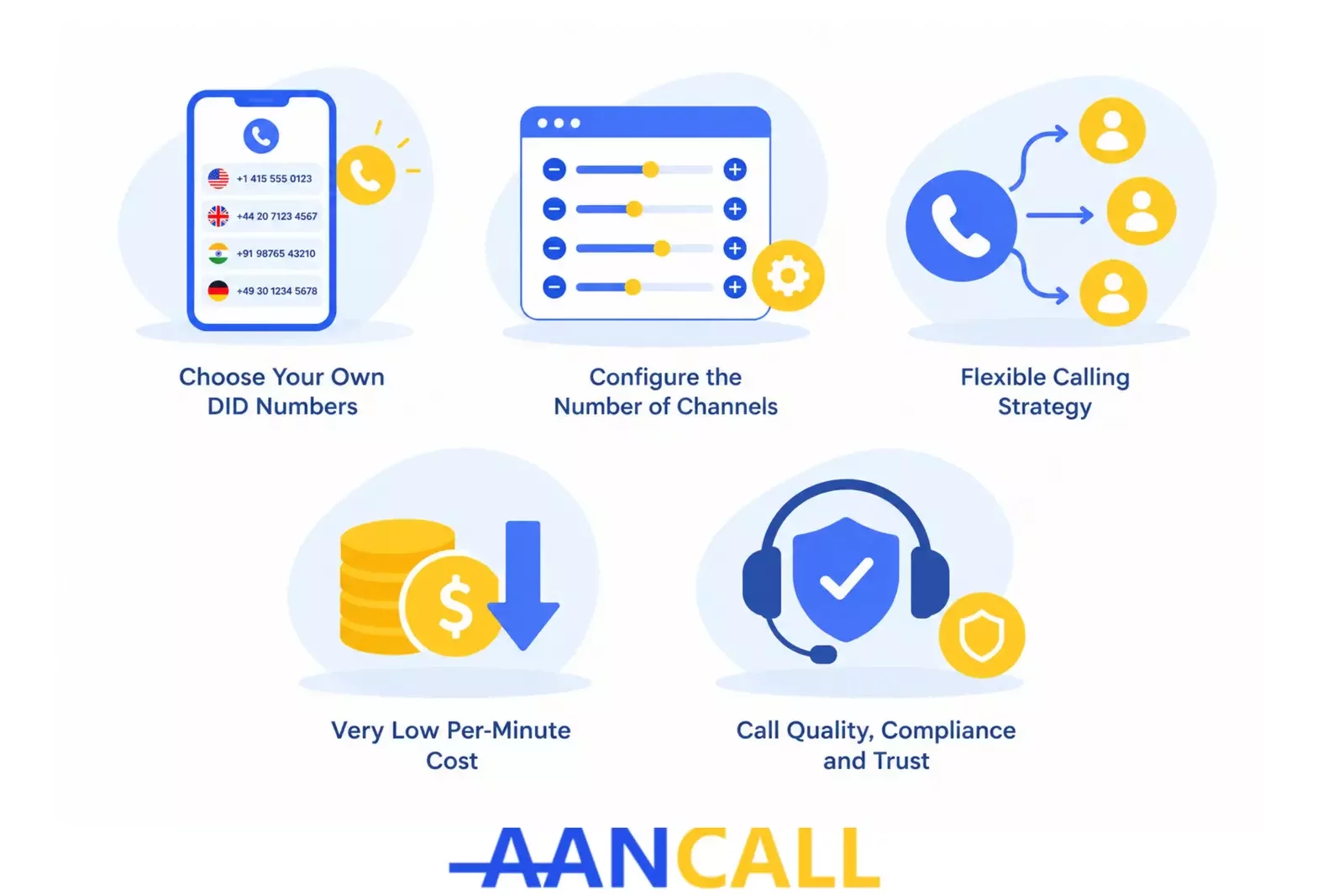
4. The Five Things to Look for in a SIP Trunk for AI Voice Agents
Not every SIP trunk is built with voice AI in mind. Traditional trunks were designed for desk phones and PBX systems. AI agents behave differently: bursts of concurrent calls, strict latency needs, and heavy outbound dialling.
Here's what actually matters.
4.1 Choose Your Own DID Numbers
Your number is part of your brand. A local number builds trust. A toll-free number signals a serious business. Being able to pick your own DIDs means you can:
- Match local numbers to your customers' area codes (US), STD codes (UK) or city codes (Australia, Singapore)
- Use toll-free numbers (US 800/888, UK 0800/0808, Australian 1800, Singapore 800)
- Run different numbers for different agents, campaigns or brands
- Keep your existing numbers by porting them in
Ask any provider: Can I choose the exact numbers I want, or am I assigned a random block?
4.2 Configure the Number of Channels
A channel is one simultaneous call. If you have 20 channels, you can run 20 calls at once, inbound and outbound combined.
This is where AI differs from humans. A human agent handles one call at a time. An AI agent can handle hundreds in parallel, if your trunk lets it. A fixed, tiny channel limit is the quickest way to strangle your voice AI.
Look for a provider that lets you:
- Start small (say, 5 to 10 channels) for testing
- Scale up as your volume grows
- Add burst capacity for campaigns or seasonal peaks
- Avoid long contracts just to increase capacity
4.3 Flexible Calling Strategy
"Calling strategy" is a polite way of saying how your calls are routed, presented and managed. For voice AI, it can make or break your answer rates and customer experience.
Useful options include:
- Outbound routing choices: Different route quality and cost tiers for different use cases
- Caller ID control: Present a number your customers recognise and can call back
- Local presence: Use numbers local to the person you're calling
- Failover routing: If one route or endpoint fails, calls move to a backup automatically
- Concurrency and pacing controls: Stop your agent hammering a single destination
- Time-of-day and geography rules: Respect calling hours and regional regulations
Match the strategy to the job. A customer-support line needs reliability and fast answer. An appointment-reminder campaign needs good caller ID reputation and sensible pacing.
4.4 Very Low Per-Minute Cost
Voice AI has several cost layers: the language model, speech-to-text, text-to-speech, the platform fee, and telephony. Telephony is the one layer you can often cut dramatically by going BYOT.
When you compare providers, don't just look at the headline rate. Check:
- Per-minute rates for the exact destinations you call (US, UK mobile vs landline, Australia, Singapore)
- Billing increments (per-second is far kinder than per-minute rounding for short AI calls)
- Monthly number rental fees
- Channel fees, setup fees and minimum commitments
- Inbound toll-free per-minute charges, which are often overlooked
With AI agents making thousands of short calls, per-second billing alone can save a surprising amount.
4.5. Call Quality, Compliance and Trust
Cheap minutes are worthless if the audio is choppy or your calls get labelled "Scam Likely".
Look for:
- Low latency and clean audio. AI speech recognition is less forgiving than human ears
- STIR/SHAKEN attestation for US calls, so your outbound calls are more likely to be trusted by carriers and shown properly on handsets
- Robocall mitigation measures and a provider that takes compliance seriously
- Support for TLS/SRTP where your platform supports it
- Real people to talk to when something breaks
Compliance matters especially for AI calling. In the US, the FCC has made clear that AI-generated voices in robocalls fall under the Telephone Consumer Protection Act (TCPA), so consent and disclosure rules apply. In the UK, Ofcom and the ICO regulate calling and marketing, and Australia and Singapore have their own do-not-call regimes. Always get proper legal advice for your campaigns.
5. Step-by-Step: Connecting a SIP Trunk to Your AI Voice Agent
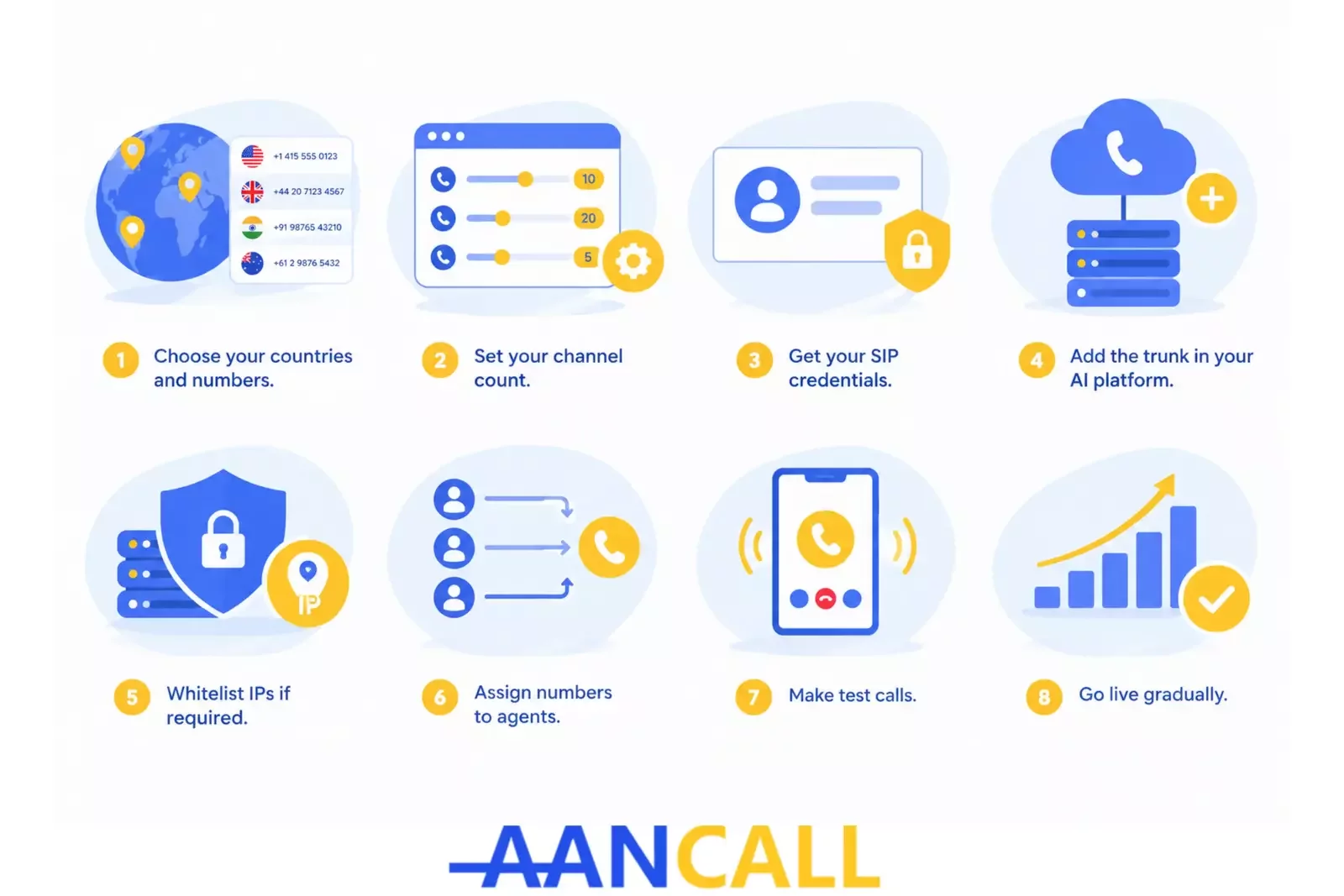
The exact screens differ between platforms, but the process is nearly always the same:
- Choose your countries and numbers. Decide where your callers are, then pick DIDs (local, national, mobile or toll-free) to match.
- Set your channel count. Estimate your peak concurrent calls and add a little headroom.
- Get your SIP credentials. Your provider supplies a SIP domain/IP, authentication details and supported codecs.
- Add the trunk in your AI platform. Enter the SIP details in the telephony or SIP trunk settings (Cognigy Voice Gateway, ElevenLabs, Vapi, Retell and so on).
- Whitelist IPs if required. Some setups need both sides to allow each other's signalling and media IP addresses.
- Assign numbers to agents. Map each DID to the right voice agent or flow.
- Make test calls. Inbound and outbound. Listen for latency, echo, one-way audio and dropped calls.
- Go live gradually. Start with a small share of traffic, watch the metrics, then scale.
6. Which Markets Matter? USA, UK, Australia,UAE, South Africa and Singapore
6.1 United States
The United States is one of the largest markets for AI-powered voice applications, making number availability, outbound caller ID, call quality and number reputation important considerations. Businesses may use local numbers, toll-free numbers or other supported number types depending on the purpose of the AI voice agent.
For outbound calling, caller ID authentication and reputation management are particularly important. STIR/SHAKEN helps authenticate caller ID information across participating networks, but it does not guarantee that calls will avoid spam labels. Calling patterns, complaint rates, number history and carrier analytics can also affect how calls are handled.
What to consider:
- Local numbers for city- or region-specific presence
- Toll-free numbers for nationwide customer service and support
- STIR/SHAKEN support and appropriate caller ID practices
- Number reputation and spam-label monitoring
- Sufficient concurrent channels and outbound calling capacity
- Applicable rules for automated, prerecorded or AI-assisted outbound calls
For AI voice agents making outbound calls at scale, choose a provider that can support your expected traffic while helping you maintain compliant caller ID and calling practices.
6.2 United Kingdom
The UK supports several number ranges for different business communication requirements. Geographic numbers generally use 01 or 02 prefixes, while 03 numbers provide a non-geographic option. Businesses can also use 0800 and 0808 freephone numbers for supported use cases.
For AI voice deployments, getting a UK number is only one part of the setup. You also need to confirm whether the number type, caller ID presentation and intended calling pattern are supported by your SIP provider and AI voice platform.
What to consider:
- 01/02 geographic numbers for local business presence
- 03 numbers for non-geographic business communication
- 0800/0808 freephone numbers for supported customer-service use cases
- Caller ID presentation and number ownership
- Applicable Ofcom requirements and marketing-call rules
- Inbound and outbound routing requirements
- Number portability if you are moving existing business numbers
If your AI agent handles customer service, sales or other business calls in the UK, verify that your provider supports the exact number range and calling use case before building the telephony architecture around it.
6.3 Australia
Australia has several business number categories, including geographic numbers, 1300 numbers, 1800 freecall numbers and mobile numbers. The appropriate option depends on whether the AI agent is handling local business calls, nationwide customer service, sales or another use case.
Geographic numbers can provide a local presence, while 1300 and 1800 numbers can provide a broader business contact point. For outbound AI calling, businesses should also consider applicable telemarketing requirements and the Australian Do Not Call Register.
What to consider:
- Geographic numbers for local business presence
- 1300 numbers for business and customer-service use cases
- 1800 freecall numbers for eligible business applications
- Mobile numbers where the use case requires them
- Caller ID and outbound number presentation
- Applicable Do Not Call requirements for telemarketing
- Number availability and geographic restrictions
Before deployment, confirm that your SIP provider can supply the required Australian number type and connect it to your chosen AI voice platform.
6.4 Singapore
Singapore is a highly connected market with strong adoption of digital communications and cloud-based business services. AI voice agents can support customer service, appointment handling, lead qualification and other conversational workflows, but telephony planning still needs to account for local number availability and applicable regulations.
Number availability and permitted use can vary depending on the number type and provider. It is therefore important to verify the exact requirements before selecting your SIP trunk, DID and outbound calling setup.
What to consider:
- Availability of Singapore business numbers
- Supported number types for your use case
- Caller ID presentation
- Inbound and outbound SIP connectivity
- Number ownership and portability requirements
- Applicable Do Not Call and telemarketing requirements
- Calling capacity for AI-driven outbound campaigns
If your AI voice agent will handle Singapore traffic, confirm number availability, outbound calling support and applicable requirements with the carrier before deployment.
6.5 United Arab Emirates
The UAE is an important market for businesses serving customers across the Middle East, with demand for cloud communications and AI-powered customer-service applications. Businesses may require UAE geographic numbers or other supported business number types depending on their use case and licensing requirements.
For AI voice deployments, number availability and regulatory requirements should be confirmed before selecting a SIP trunk. Caller ID presentation is also important because businesses need to ensure that the number displayed to customers is supported and legitimately assigned.
What to consider:
- UAE geographic numbers for local business presence
- Supported business and service number types
- Caller ID presentation and number ownership
- Inbound and outbound SIP connectivity
- Number portability where applicable
- Local licensing and telecommunications requirements
- Restrictions that may apply to VoIP or international calling
- Support for the UAE numbers required by your AI platform
If you plan to deploy an AI voice agent in the UAE, confirm the required number type, permitted calling use case and SIP connectivity with your carrier before implementation.
6.6 South Africa
South Africa is a significant business and customer-service market in Africa, with geographic numbers, mobile numbers and toll-free services available for different communication requirements. The right number type depends on whether your AI voice agent is supporting a local business, customer service operation, sales team or nationwide service.
For outbound AI calling, businesses should pay particular attention to caller ID presentation, number reputation and applicable direct-marketing requirements. Number availability can also vary depending on the provider and the intended use.
What to consider:
- Geographic numbers for local business presence
- Mobile numbers for supported business use cases
- Toll-free numbers for customer-service applications
- Caller ID presentation and number ownership
- Inbound and outbound SIP support
- Number portability where applicable
- Applicable direct-marketing and Do Not Call requirements
- Calling capacity for AI-driven voice traffic
Before deployment, verify that your SIP provider can supply the required South African number type and support connectivity with your AI voice platform.
6.7 Serving Multiple Markets
If your AI voice agents serve customers across the US, UK, Australia, Singapore, UAE and South Africa, managing each market through separate telephony providers can quickly increase operational complexity. A SIP provider that supports multiple countries can simplify number management, routing, billing, monitoring and technical support.
However, global coverage should not be the only selection criterion. Compare number availability, caller ID support, SIP connectivity, concurrency, outbound capacity, pricing, compliance support and geographic restrictions for each market you plan to serve.
A provider that supports your target regions through a consistent SIP infrastructure can make it easier to scale your AI voice operation without rebuilding the telephony layer for every new market.
7. Common Mistakes (and How to Avoid Them)
- Under-buying channels: Your AI works brilliantly in testing, then calls get rejected during a campaign. Always plan for peak, not average.
- Ignoring codec compatibility: Mismatched codecs cause bad audio or failed calls. Stick with G.711 unless you've a reason not to.
- Forgetting caller ID reputation: A brand-new number blasting thousands of calls on day one can get flagged. Warm numbers up and pace your outbound.
- Choosing on price alone: The cheapest trunk with poor routes will cost you in lost conversations.
- Locking into long contracts: AI projects evolve fast. Pick flexibility.
- Skipping failover: One route going down shouldn't take your whole voice agent offline.
Why Choose Aancall as Your SIP Trunk for AI Voice Agents
Aancall is an FCC-registered cloud communications and SIP/VoIP provider serving businesses across the USA, UK, Middle East and Australia.
For AI voice and voicebot teams, here's what that means in practice:
- Choose your own DID numbers: Local, toll-free and virtual numbers in the countries you operate in
- Configurable channels: Start small and scale as your agents grow
- Flexible calling strategy: Routing, caller ID and failover options to suit different use cases
- Very low per-minute rates: Built for high-volume voice AI workloads
- STIR/SHAKEN A-attestation and Robocall Mitigation: Helping protect your number reputation and answer rates
- Works with the platforms you're already using: Cognigy, ElevenLabs, Pinkfish, Vapi, Retell, LiveKit and more
Conclusion
Voice AI is moving fast, and the businesses winning with it have one thing in common: they treat telephony as part of their product, not an afterthought. Your agent might have the smartest model and the loveliest voice, but if the phone line behind it is expensive, limited or unreliable, customers will notice.
BYOT puts you back in control of your numbers, your capacity, your routing and your costs. Choose the right trunk once, and you can swap or add AI platforms as the market evolves, without ever changing your phone number.
FAQs
What Is a SIP Trunk for AI Voice Agents?
It's a virtual phone line that connects your AI voice agent or voicebot to the regular phone network, so it can make and receive real calls over the internet using SIP (Session Initiation Protocol).
What Does BYOT Mean for Voice AI?
BYOT means Bring Your Own Telephony. Instead of using your AI platform's built-in phone numbers and minutes, you connect your own SIP trunk and numbers. You'll also see it called BYOC (Bring Your Own Carrier) or BYOSIP.
Why Would I Use My Own SIP Trunk Instead of My AI Platform's Phone Numbers?
Usually for lower cost, more number choice, higher call capacity, better routing control and the freedom to move platforms without losing your numbers.
Is BYOT Cheaper Than Built-In Telephony?
Often, yes, especially at volume. But compare total costs, including number rental, channel fees and billing increments, not only the headline per-minute rate.
Do I Need Technical Skills to Set Up a SIP Trunk for My Voicebot?
Basic familiarity helps, but most setups mean copying a few SIP details into your platform's settings. A good provider will walk you through it.
Can I Use My Own SIP Trunk With Cognigy?
Yes. Cognigy's Voice Gateway is designed to work with external SIP carriers, which is why it's popular in enterprise contact centres. Check Cognigy's current documentation for exact configuration steps.
Does ElevenLabs Support SIP Trunking?
ElevenLabs' agents platform supports connecting your own SIP trunk so you can use your own numbers and carrier. Check their latest docs for supported transports and encryption options.
Can I Use a SIP Trunk With Pinkfish?
Does Vapi Support Bring-Your-Own SIP Trunk?
Yes, Vapi supports importing your own SIP trunk and numbers for inbound and outbound calls.
Can I Use My Own Telephony With Retell AI?
Does Bland AI Support BYOT?
Bland supports bringing your own telephony for teams that want more control over numbers and cost. Check their documentation for the current setup process.
Does LiveKit Work With SIP Trunks?
Which AI Voice Agent Platforms Support BYOT?
Many do, including Cognigy, ElevenLabs, Vapi, Retell AI, Bland AI, Synthflow, LiveKit, Pipecat/Daily and several enterprise platforms. Support and features change regularly, so always verify with the vendor.
Can One SIP Trunk Serve Multiple AI Platforms?
Generally yes. You can assign different numbers or channel allocations to different platforms, which is handy if you're testing several.
Can I Choose My Own DID Numbers?
With Aancall, yes. You can select numbers by country, area and type (local, toll-free or virtual) rather than being handed a random set.
Can I Port My Existing Numbers to a SIP Trunk for My AI Agent?
Usually, yes. Porting lets you keep your current business numbers and point them at your AI agent. Timelines and requirements vary by country and number type.
What's a Channel in SIP Trunking?
How Many Channels Does My AI Voice Agent Need?
Estimate your busiest hour, multiply calls by average duration, and add headroom. As a rough guide, if you expect 100 calls of 3 minutes in an hour, you'd need roughly 5 channels on average, but peaks need more. Always plan for bursts.
Can I Increase My Channels Later?
You should be able to. Flexible scaling is one of the main reasons to choose a provider built for AI workloads.
Can I Use Toll-Free Numbers With My Voicebot?
Can I Get UK Numbers for My AI Agent?
Can I Get Australian or Singapore Numbers for AI Voice Agents?
Availability depends on the number type and local rules. Ask your provider which numbers they can supply and what documentation is required.
What Is a Calling Strategy in SIP Trunking?
It's how your calls are routed, presented and controlled: route quality tiers, caller ID, failover, pacing and local-presence options.
What Is Local Presence Dialling?
It means showing the person you're calling a number local to them, which often improves answer rates. You must follow the rules in each country regarding caller ID.
Which Codec Is Best for AI Voice Agents?
G.711 (µ-law or A-law) is the standard choice. It's uncompressed enough for speech recognition to work accurately and is widely supported.
What Causes Latency in AI Voice Calls?
Why Is There a Delay Before My AI Agent Responds?
It's usually the AI pipeline, not the trunk, but poor routing or distant servers can add to it. Test with different regions if you can.
Does a SIP Trunk Work With Real-Time Conversational AI?
Should I Use UDP, TCP or TLS?
UDP is common, but TLS with SRTP adds encryption where your platform supports it. Choose based on your security requirements and platform compatibility.
How Do I Stop My AI Calls Being Marked as Spam?
How Much Does a SIP Trunk Cost for Voice AI?
It varies by destination, number type, channels and billing increment. Compare per-minute rates, number rental and any channel fees. Aancall offers very low per-minute pricing built for high-volume voice AI. [Insert link to rates page]
Is Per-Second Billing Better for AI Voice Agents?
Usually, yes. AI calls are often short, and per-minute rounding can inflate costs noticeably at scale.
Are There Hidden Costs With SIP Trunking?
Watch for setup fees, minimum commitments, number rental, channel charges and costs for toll-free inbound minutes. A transparent provider lists them clearly.
Do I Pay for Unused Channels?
Is It Legal to Use AI Voice Agents for Outbound Calls?
It depends on the country and the type of call. In the US, the FCC has ruled that AI-generated voices in robocalls fall under the TCPA, so consent matters. UK, Australia and Singapore have their own rules. Please take proper legal advice.
What Is STIR/SHAKEN and Why Does It Matter?
STIR/SHAKEN is a framework that helps verify caller ID on US calls. Higher attestation levels help your calls be trusted and displayed correctly, reducing spam labelling.
Do I Need to Tell People They're Speaking to an AI?
Disclosure requirements are growing and vary by region. It's good practice, and in some cases a legal requirement, to be upfront.
Can I Record Calls Handled by My AI Agent?
Often yes, but you need to follow local consent and data protection laws such as GDPR in the UK and EU.
How Long Does It Take to Set Up a SIP Trunk for My Voice Agent?
Provisioning a trunk and connecting it to your platform can often be done quickly, sometimes within the same day. Number porting usually takes longer.
What Details Do I Need to Give My AI Platform?
Typically SIP server address, authentication method (IP or credentials), transport protocol, codecs and your numbers in E.164 format.
What If I Get One-Way Audio or No Audio?
Can I Run Both Inbound and Outbound AI Calls on the Same Trunk?
Yes. Channels are shared across both directions.
Can I Move My Numbers to Another AI Platform Later?
What's the Best SIP Trunk Provider for AI Voice Agents?
The best one is the one that gives you flexible numbers, adjustable channels, good routing options, clean call quality, compliance support and low per-minute rates, with people you can actually reach when you need help. That's what we've built Aancall around.
Latest from the Blog
Practical insights, guides, and strategies for modern business communication.
View All Blogs→
Compare VoIP vs traditional landlines for UK enterprises. Explore 11 key differences, pros and cons, costs, reliability, scalability, security and features.
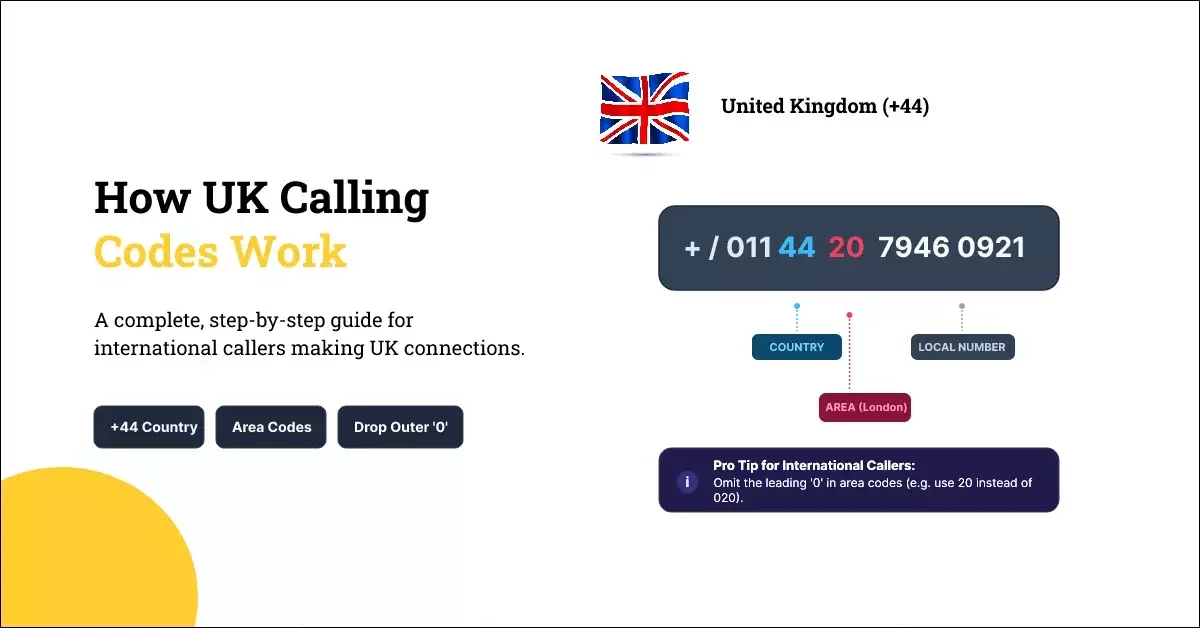
Learn how UK calling codes work, including +44, geographic area codes, mobile numbers, international dialing formats, and common UK phone number mistakes.


